Saturday, 4 August 2012

“SHOW TIME” EPIC ROBOTIC LANDING ON MARS


Curiosity landing on Mars on 5th August 2012. NASA 2012.Curiosity, the largest robotic rover ever built by NASA, will touch-down on Mars this Monday 6 August 2012. NASA-TV will broadcast the landing “live” from the control room at JPL (low definition here).

The show starts at 4am Monday (UK) or 1pm Eastern US time (5th August). The historical landing is expected to take place at 06:31am.

The term “live” is not quite so accurate in this case, due to the delay of signals reaching our planet. Even travelling at the speed of light, data from Mars takes around 14 minutes to get to Earth. Sending a response or command would take another 14 minutes. This means that everything we’ll see will always be old news.

As two-way communication to control the spacecraft remotely during landing is out of the question, the next best option was to choreograph the landing based on our knowledge and experience of travelling in space, and trust her robotic capabilities to make adjustments towards a successful touch-down. No room for last minute corrections. No change of plans. No second chance.

This will be it! … The ultimate test to human ingenuity and technological skill ...

Seven minutes of terror

Adam Steltzner. Entry, Descent and Landing Phase Lead. NASA/JPL 2012.Curiosity launched from Cape Canaveral in Florida, on board an Atlas V 541 rocket on 25 November 2011. After 8 months and 560 million kilometres across our solar system, it has arrived to its final destination, Mars.

On the early hours of Monday 6th August (UK time), she will enter the Martian atmosphere at nearly 20,000 km/h reaching more than 10G of acceleration.

Firing her own Reaction Control Jets, the spacecraft will be able to steer as she crosses the atmosphere engulfed in a ball of fire, resulting from friction of gas particles against her protective heat-shield.

Falling at Mach 2, twice the speed of sound, she will deploy a gigantic 21m-diameter supersonic parachute to slow down her free-fall. With the first glimpse of the ground on her radar, Curiosity will calculate her speed and height to separate from the chute and stir away from its path thanks to her Descent Stage vehicle. This vehicle has 8 Mars-Landing rocket engines powerful enough to decelerate down to an amazingly controlled speed of 2.5 km/h.

At 20 metres from the ground at Gale Crater, a bridle will slowly separate the lander from the descent stage and as soon as Curiosity touches Martian terrain, the descent stage will separate and take off to land some distance away.

From entering the atmosphere to touching the ground will take 7 minutes. By the time the news arrive to Earth, the destiny of Curiosity will be sealed. She will be triumphant or dead ... (Adam Steltzner).

The Gale Crater, south of the equator on Mars, was carefully selected as the landing zone. A team of specialist in trajectory and navigation have the task of steering the spacecraft towards that target.

Trajectory of expected entry and touchdown zone for landing. MRO, 3 August 2012. NASA 2012.After a few recent adjustments the spacecraft is bound to enter the atmosphere at the precise point and land as close as possible to the chosen point. This is a complex and difficult calculation task, considering the distance away from Earth and that the only means to calculate positions in space is from data sent by satellites near Earth.

Tomas Martin-Mur, Navigation Team Chief, compares this task to steering a racing car based on the position of distant buildings that you can only see through the back window.

Another JPL team, led by Ashwin Vasavada, is in charge of forecasting weather conditions on Mars with the help of the Mars Reconnaissance Orbiter (MRO). This spacecraft has been orbiting and monitoring the red planet for the last few years, sending temperature readings and colour images, which are now used by scientists to predict the Martian weather.

Mars is currently coming out of its Winter and is therefore expected to be cold and possibly windy. Images of the planet, sent by MRO on 1st August 2012, show water-ice clouds and dust storms. Curiosity is prepared to withstand most climatic conditions that may occur that day.

Ashwin Vasavada. Deputy Project Scientist, Weather Prediction. NASA/JPL 2012. Comparison of Weather Map of Mars and Earth. Note location of Gale Crater. MRO, 1 August 2012. NASA 2012.

Another variable to take into account is space weather. Solar flares or plasma ejected from the sun can affect navigation systems on the spacecraft. A number of space probes are constantly monitoring the sun for this purpose.

Eyes on the Solar System

Go To: Eyes on the Solar System. NASA/JPL 2012.A scientific group at Jet Propulsion Laboratories (JPL) in Pasadena, California, recently developed a new online tool called “Eyes on the Solar System.” It opens a window into space exploration and features the many probes and missions currently in operation in space.

The programme is an amazing 3-D computer simulation based on current data that allows the viewer to move across space and find out what the probes are doing and where they are.

Curiosity or MSL is one of the highlights, and besides providing real-time positioning in space, it also offers a real-time simulation of the landing on Mars. You can follow all the landing phases in real-time and pause the animation, zoom-in to see more detail and move around at will.

This magnificently produced tool will give space enthusiasts a unique view of the current state of space exploration, and best of all, in true NASA/JPL style, access is free for everyone to use. You may need a modern computer with connection to the Internet and all you have to do is visit their website at http://eyes.nasa.gov

Eyes on the Solar System – Control Panel. NASA/JPL 2012. Eyes on the Solar System – MSL Landing Stages. NASA/JPL 2012.

The Mission

Doug McCuistion. Mars Exploration Program Director. History of the Mars Programme since 2001. NASA 2012.The rover Curiosity is the star of a mission called Mars Science Laboratory (MSL), which was conceived many years ago and is the latest addition to a progressive set of missions designed to reach and learn about our neighbouring planet.

With a price tag of 2.5bn dollars, the MSL project has been quite beneficial to our economy in the last decade. It generated quality employment in science and technology for more than 7000 people in USA and 10 other countries including Canada, Spain, Japan and others. Future prospects to continue space exploration will secure more opportunities around the world.

Doug McCuistion, Mars Exploration Programme Director, based at NASA Headquarters, recently described the last decade of missions as he summarised its achievements:

  • 2001 – Odyssey, captured images.
  • 2003 - Mars Express, collaborated with the first rovers: Spirit and Opportunity.
  • 2005 – Mars Reconnaissance Orbiter (MRO), participating actively in the current mission.
  • 2007 – Phoenix lander.
  • 2011 – Curiosity the Mars Science Laboratory (MSL).
  • 2013 – MAVEN will help understand the past of the planet.
  • 2016 and beyond – Human precursor missions.

Curious about Curiosity? >> Read our article Mars Rover – A Science Lab

William Shatner, who played Captain Kirk, commander of the Enterprise on the famous TV series StarTrek, talks about the virtues and the journey of one of the most daring and exciting projects of humankind.


References


¤ Amos, J. (2012) ‘Nasa's Curiosity rover on course for Mars landing’ BBC News. [Online]. Available here. (Accessed: 03 August 2012).

¤ ‘MSL Mission engineering overview’ (2012). NASA. [Online]. Available here. (Accessed: 03 August 2012).

¤ Renart (2011). ‘Mars Rover – A Science Lab’. [Online]. Available here. (Accessed: 03 August 2012).


Images


¤ All images edited by ren@rt. Source: NASA.

Friday, 20 April 2012

DISCOVERY REBORN AFTER EASTER – MISSION TO EDUCATE

Discovery is transferred to the care of the National Air and Space Museum in Chantilly, Virginia, 19 April 2012. NASA 2012.The Space Shuttle Discovery started a new mission after its retirement. She will become an engine of Imagination, Inspiration and Education in her new home at the Smithsonian’s National Air and Space Museum in Chantilly, Virginia.

Gen. Jack Dailey, director of the museum welcomed the new arrival on 19 April 2012. A large audience attended the ceremony, in which the shuttles Enterprise and Discovery were united. Among the attendees were 15 of the 32 commanders and many of the crews that had the privilege to ride on the space shuttle during her 30 years of space exploration.

This iconic vehicle will now join other marbles of technology and flight at one of the most prestigious museums in the world.

Discovery was put together in 4 years at the Shuttle Factory in Palmdale, California, from where it was delivered to NASAs Kennedy Space Centre in Florida in November 1983. She flew her first mission, STS-41, on 30 August 1984 (STS stands for Space Transportation System).

The shuttle completed 39 missions, spent 365 days in space, orbited the Earth 5,830 times, and travelled 238 million kilometres (148 million miles).

Shuttle Orbiters Enterprise and Discovery at the ceremony of transfer to the Smithsonian Institution, 19 April 2012. NASA 2012.During her missions, she released Hubble Telescope in 1990 (mission STS-31), launched many satellites, carried many research laboratories, was the first shuttle to reach and dock with the International Space Station in 1999 (STS-96), and in her last mission carried the first experimental robot “Robonaut 2.”

Discovery’s last touchdown was on runway 15 of Kennedy Space Centre in Florida, at 16:57 UTC on Wednesday 9th March 2011, marking the conclusion of Mission STS-133. The last crew on board was composed by: Commander Steve Lindsey, pilot Eric Boe, and mission specialists Nicole Stott, Mike Barratt (medic), Steve Bowen and Alvin Drew.

After a year of preparations for exhibition, Discovery was flown mounted atop NASA's Shuttle Carrier Aircraft (SCA), a modified Boeing 747 jetliner, from Kennedy Space Centre in Florida to Washington Dulles International Airport in Sterling, Virginia on 18 April 2012. The next day she was towed by road (courtesy of Signature Flight Support and Swissport) to its final destination at the Smithsonian’s Udvar-Hazy Centre.

Among the speakers at the ceremony was Senator John Glenn, who in November 2011 received the highest civilian award bestowed by Congress, The Congressional Gold Medal for his pioneering contributions to space exploration. He flew to orbit for the first time in 1962 on board Mercury Friendship 7 and returned to space at the age of 77 on board Discovery as Payload Specialist in 1998 (STS-95). He reminded the audience of the history and highlights of the shuttle and talked about the future of this vehicle, which will become a symbol of achievement and inspiration for future generations, representing optimism, hope, challenge, leadership and aspiration to explore and to excel.

Certificate of transfer of Discovery from NASA to the Smithsonian Institution signed by three authorities and a witness, 19 April 2012. NASA 2012.Astrophysicist Dr. France Cordova, former chief of research at NASA, currently president of Purdue University in West Lafayette, Indiana and Chair of the Smithsonian Board of Regents, talked about the contribution of the university to the space program. This institution not only provided hundreds of engineers and scientists to NASA but 22 of their alumni went to space, including the first and last astronauts who went to the moon.

At the end of the ceremony, the official paper: “Certification of Retirement of Space Shuttle Orbiter Discovery (OV-103) & Acknowledgment of Transfer from NASA to the Smithsonian Institution”, was signed by the three authorities: J R Dailey, Director of the National Air and Space Museum; Charles F. Bolden, Jr., Administrator of NASA (National Aeronautics and Space Administration) and G. Wayne Clough, Secretary of the Smithsonian Institution. Senator John H. Glenn, Jr. acted as witness.

So there you go Discovery, God Speed in your new mission, one that will touch generations to come. Thanks for the service to humanity and thanks to NASA and all those thousands of people involved in one way or another in turning the mankind dream of exploring space into a reality.

And this is only the beginning …


The crew that flew Discovery on her last mission

The crew of Mission STS-133 (24 February to 9 March 2011):
Commander Steve Lindsey, pilot Eric Boe, and mission specialists Nicole Stott, Mike Barratt (medic), Steve Bowen and Alvin Drew seen here before the launch of their mission. The bottom picture was taken when they met the President of the United States in May 2011.

Crew of Discovery’s last mission STS-133, before and after their flight on Feb-Mar 2011. NASA 2011.

Attending commanders

Karol Bo Bobko 1985 (STS-51-D), Joe Engle 1993 (STS-51-I), Mike Coats 1989, 1991 (STS-29 + 39 now director of Johnson’s Space Centre), Fred Gregory 1989 (STS-33), Bob Cabana 1992 (STS-53 now Director of Kennedy Space Centre), Ken Cameron 1993 (STS-56), Frank Culbertson 1993 (STS-51), Charlie Bolden 1990, 1994 (STS-31 + 60 now Administrator of NASA), Curt Brown 1997-98-99(STS-85 + 95 + 103), Scott Horowitz 2001 (STS-105), Steve Lindsey 2006 + 2011 (STS-121 + 133), Eileen Collins 1995 (STS-63), C J Sturckow, Alan Poindexter.

Karol Bo Bobko 1985 (STS-51-D). NASA 2012.Joe Engle 1993 (STS-51-I). NASA 2012.Mike Coats 1989, 1991 (STS-29 + 39 now director of Johnson’s Space Centre). NASA 2012.

Fred Gregory 1989 (STS-33). NASA 2012.Bob Cabana 1992 (STS-53 now Director of Kennedy Space Centre). NASA 2012.Ken Cameron 1993 (STS-56). NASA 2012.

Frank Culbertson 1993 (STS-51). NASA 2012.Charlie Bolden 1990, 1994 (STS-31 + 60 now Administrator of NASA). NASA 2012.Curt Brown 1997-98-99(STS-85 + 95 + 103). NASA 2012.

Scott Horowitz 2001 (STS-105). NASA 2012.Steve Lindsey 2006 + 2011 (STS-121 + 133). NASA 2012.Eileen Collins 1995 (STS-63). NASA 2012.
C J Sturckow and Alan Poindexter. NASA 2012.

Speakers


General Jack Dailey, Director of the Smithsonian’s National Air and Space Museum. NASA 2012.Charles Bolden, NASA administrator. NASA 2012.John Glenn, former Senator and NASA astronaut. NASA 2012.
France Cordova, Chair of Smithsonian Regents. NASA 2012.

References


¤ ‘NASA Transfers Space Shuttle to NASM’ (2012). NASA Channel. [Online]. Available here. (Accessed: 20 April 2012).
¤ Pearlman, R. (2012). ‘Space Shuttle Discovery Enters Smithsonian for Museum Display.’ Space.com [Online]. Available here. (Accessed: 20 April 2012).
¤ ‘Space Shuttle Discovery’ (2012). Wikipedia. [Online]. Available here. (Accessed: 20 April 2012).
¤ Renart (2011). ‘Discovery returns safely from her last flight’. [Online]. Available here. (Accessed: 20 April 2012).
¤ ‘World’s Greatest Piggyback Ride’ (2012). NASA. [Online]. Available here. (Accessed: 20 April 2012).

Images


¤ All images edited by ren@rt. Source: NASA.

Monday, 7 November 2011

MARS ROVER “CURIOSITY” - A SCIENCE LAB (MSL)

Mars Science Laboratory (MSL) Curiosity Rover. Launch: 25 November 2011. Will arrive in Mars on 5 August 2012. NASA + JPL + Ren@rt, 2011.

Mars is recognized by many scientists as humanity’s next point of exploration after the Moon. The next missions to our natural satellite will help build capabilities to eventually send humans to Mars.

NASA’s Jet Propulsion Laboratory (JPL) in collaboration with other space agencies around the world has been working in a new generation of Mars Explorer Rover named “Curiosity.” It launched flawlessly in a 9-month journey towards Mars on 26 November 2011 on board a United Launch Alliance Atlas V rocket.

Shortly after launch, March Science Laboratory (MSL) project manager Pete Thaisinger thanked the team at Kennedy Space Centre in Florida for a professionally smooth launch operation. He also thanked the 250 scientists at Jet Propulsion Laboratory for 10 years of work putting together this unique piece of equipment.

The panel at the post-launch conference also included John Grotzinger, Project Scientist from California Institute of Technology and Doug McCuisition, Director of the Mars Exploration programme from NASA. These representatives reminded the media that this is not a life detection mission but an intermediate mission between Mars Exploration Rover (MER) which was sent to detect water and future missions to detect life. This mission is about looking for ancient habitable environments, when circumstances in Mars were very different than what they are today; therefore, selecting the landing and exploration site was crucial for its prospects of success.

Launch of MSL on board an Atlas V Rocket
On 26 November 2011, a United Launch Alliance (ULA) Atlas V rocket launched successfully carrying the MSL.
The following two videos cover from Count-down to launch and separation of MSL.
Farewell “Curiosity,” God Speed on your 9-month journey to Mars!

Launch of United Launch Alliance (ULA) Atlas V rocket carrying MSL: 26 November 2011. MSL Curiosity will arrive in Mars on 5 August 2012. NASA + Ren@rt, 2011.

The strategy to gather images will be different than that of previous rover missions. During the MER missions, scientist would receive all static images from the rovers, and from those, build a selection and decide the locations worth shooting with the panoramic camera. This time, Curiosity will take pictures and store them in a memory buffer, then only send a set of thumbnails for scientists to select a meaningful sub-set and later downlink only the chosen full resolution images. This will allow for more efficient use of the limited communication channels.

During the mission, scenarios will be carefully assessed and practice runs will be simulated on the twin version of the rover at JPL. After this training scientists will send precise commands for the execution of those complicated manoeuvres.

The cost of the programme was also discussed and the panel reasoned that this is a bargain of an investment as the cost is close to that of a modern movie, not to mention the thousands of jobs maintained and created around this endeavour. The benefits will be immense and only understood and valued by coming generations of humans. We must not forget that all the money that goes into the programme is spent on Earth, not on Mars.

Curiosity, the Rover

The name of the project is Mars Science Laboratory (MSL), an all-weather, all-terrain vehicle created with the purpose of exploring Mars looking for an answer of the age-old question: Was Mars ever capable of sustaining life?

This multinational rover was put together at the Spacecraft Assembly Facility of Jet Propulsion Laboratories in Pasadena, California. Space agencies of France, Russia, Canada and Spain built a number of instruments which form part of the payload of the vehicle.

The following list of facts provide an idea of the work involved in sending Curiosity to Mars. This is one of the most complex projects of JPL to date with surprising innovations resulting from the accumulated knowledge of the planet, aeronautics and space travel.

  • Mars Science Laboratory (MSL) Curiosity. After launch on an Atlas V 541 rocket, the vehicle uses a slingshot effect of an orbital segment to head away from Earth. 25 November 2011. NASA + JPL + Ren@rt, 2011.MISSION: The mission of Mars Science Laboratory (MSL), aka the “Curiosity” rover, is to search areas of Mars for past or present conditions favourable for microbial life. It will search for potential locations, acquire samples, analyse them and send reports back to Earth.
  • DURATION OF MISSION: One Martian year, this equals to 23 Earthly months until the planetary positions re-align and the crew can return home.
  • DEPARTURE: Launch is scheduled for 25 Nov 2011 from Cape Canaveral, Florida, on an Atlas V 541 vehicle (rocket).
    This vehicle will place the spacecraft in orbit and use a slingshot effect to finally release it towards Mars.
    The MSL is at this stage surrounded by an engine that will provide propulsion and correct direction. This section has solar panels to top-up its energy requirements.
  • Mars Science Laboratory (MSL) Curiosity. The capsule is released surrounded by an engine to push and correct direction towards Mars in an 8 and a half month journey. On arrival, Curiosity separates from the engine and enters the atmosphere on 5th August 2012. NASA + JPL + Ren@rt, 2011.ARRIVAL: The interplanetary journey will take eight and a half months. The expected date of arrival is 5th August 2012.
  • LANDING: This ingenious and complex landing process aims to provide maximum protection to this new generation of rover.
    The entry capsule is fitted with tiles of a new ceramic material designed to efficiently shield it from the intense heat of entry as it plummets through the Martian atmosphere towards the ground at a speed of 19,300 km/h. At this speed it would reach the surface in 5-6 minutes and probably disintegrate.
    The capsule therefore needs to be slowed down.
    Friction against atmospheric particles is expected to reduce the capsule’s speed to 1,600 km/h. Soon after, a large supersonic parachute is deployed to slow down the lander even further.
    In the next stage called the Descent, a new aircraft, the Sky-Crane comes into operation, it will actively reduce the speed of the fall to tens of metres per second thanks to a set of 8 thrusters, which consume 400kg of propellant. The Sky-Crane then will find and hover over the landing site and slowly lower the rover with a 7.5m long bridal cable, until it touches the ground on its own wheels at a speed of 0.75m/sec. The Sky-Crane then flies away to land somewhere else completing its function.
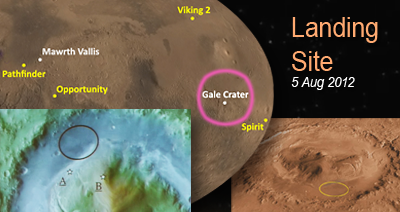
  • Mars Science Laboratory (MSL) Curiosity. The landing site is located in a wide valley inside the “Gale Crater” near the equator. The landing sites of previous missions is depicted on a planetary photo-composite map. The depth reconstruction shows the nearby 5km high mountains. The Stratigraphic view shows depths in colours. NASA + JPL + Ren@rt, 2011.LOCATION: The selection of the landing site is crucial to maximise the chances of finding the right soil to examine. Considering that Mars is about 1/3 the size of the Earth, with a surface area similar to that of dry land on Earth, finding the right site for landing was a mission in itself.
    After 7 years of study of images sent by previous missions, a final spot was chosen from around 50 candidates. Curiosity will touch-down on a relatively flat zone inside the “Gale Crater,” close to the equator. This crater was possibly created by flow of liquid or possibly winds, the hills surrounding the valley seem to expose strata, ideal for gathering geological samples.
    There is a 5 km-high mountain nearby at the centre of the crater. The mission will attempt to climb up to the bottom 1/3 of the mountain
    in 2 years, reaching areas that look like clays and sulphurs.
  • Mars Science Laboratory (MSL) Curiosity. Inside the Martian atmosphere the Capsule is slowed down by a parachute before releasing the Sky-Crane, a hovering aircraft that lowers the rover gently with a 7.5m bridal cable. NASA + JPL + Ren@rt, 2011.TRAVEL ON MARS: The Mars rover is expected to travel 5 to 20 km during the mission.
  • WHO NAMED CURIOSITY?: The vehicle was named by Clara Ma, a 12-year-old student from Lenexa, Kansas after winning a Mars Science Laboratory rover-naming contest in 2009.
  • BUILDING CURIOSITY: The MSL was built in a large clean room at JPL's Spacecraft Assembly Facility in Pasadena, California. In the clean rooms, all working engineers wear white "Bunny suits" that include booties and gloves to protect against Earthly contaminants. They also wear a grounding wire around the neck to prevent electrostatic discharge. Building in a clean room prevents contamination by biological particles, which may lead to false-positive results that invalidate findings. Clean rooms have a strict limit of tolerance of particles per cubic foot of air; the one at the assembly facility allows up to 10,000 particles greater than half a micron in size. To put this into perspective, a typical “non-clean” room may have 500,000 to one million particles per cubic foot of air.
  • COMMUNICATIONS: Signals will be relayed by spacecraft orbiting Mars: NASA's Mars Reconnaissance Orbiter and Mars Odyssey spacecraft. In addition, messages will travel through NASA's Deep Space Network, an international network of antennas that support interplanetary spacecraft missions. Signals travelling at the speed of light (300,000 km/sec) are delayed by 10 to 20min due to the distance to Mars, which is another challenge for remote operations.
  • SIZE:
    • Curiosity Rover compared in size to previous rovers and a Mini Cooper: Opportunity rover on the left is half the size and Pathfinder in the middle is 1/10 in size; Mini Cooper is about the same size. NASA + JPL + Ren@rt, 2011.Body: This is the largest Mars rover to date, twice the size of the last rover “Opportunity” and ten time the size of “Pathfinder”. It is as large as a Mini Cooper car with a height of 2.2m, a width of 2.7m and a length of 9m. It weights 900kg. Mostly made of aluminium, its suspension and spokes are made of titanium. It has a ground clearance of 60cm. The core structure is approximately 1 meter wide and long.
    • Arm: Curiosity is fitted with a single 2.2m long arm designed to manoeuvre a 30kg Turret.
      Located on the front panel, the arm provides the dexterity required to acquire material and feed it to the lab. It was constructed by the same Canadian company that made the arms of previous rovers.
    • Mars Science Laboratory (MSL) Curiosity. Turret with camera on top. Arm will have multiple instruments mounted on its free end. At the bottom a comparison of the rovers’ wheel sizes: Pathfinder, Opportunity and Curiosity on the left. NASA + JPL + Ren@rt, 2011.Turret: This conglomerate of instruments contains drilling and collecting tools. The drill head is of Rotary-Percussive or Hammer-Drill type and is designed to drill holes of up to 5cm in depth and collect the dust from the centre and the periphery of the hole. In case of a broken or jammed drill-bit, it can drop the bit and replace it with another; it carries 2 spare drill-bits.
      If biological material were found, the rover has 5 red tiles of Organic-Check-Material, which are biologically-free blocks that can be drilled to compare results and rule out false-positives resulting from biological material being carried from Earth.
    • Wheels: The 6 wheels of Curiosity are made of aircraft-grade aluminium, they are 50.8 cm in diameter and 50cm in width. Each wheel has 1.27cm thread dents and holes that leave imprints in the soil for visual odometry. The rover has a wheel-base of 2.26m.
      The solid wheels were designed to roll over obstacles of up to 75cm in height. Aluminium was chosen because it is a strong, yet light material that can tolerate denting without impact to driving ability.
    • Capability: Top speed of 140metres/h. One horsepower. Its torque or ability to drive up slopes is 3000 ft/lb (500 ft/lb on each wheel, similar to that of an average car per wheel), this is very high because the vehicle will operate in very low temperatures of -10 to -26 Centigrade (-50 -80 F). Curiosity will travel at a very low speed but with a lot of power being able to drive up 30 degree slopes.
  • Mars Science Laboratory (MSL) Curiosity. Multi Mission Radioisotope Thermoelectric Generator sits at the back end of the rover (circled). Generates constant 100Watt and the excess heat is circulated via piping (red/blue) to regulate the temperature of the unit. Picture of the real MMRTG in the back. NASA + JPL + Ren@rt, 2011.POWER SOURCE: Unlike its predecessors that use solar panels, Curiosity has a Radioisotope Thermoelectric Generator (RTG) built by Boeing, which uses the heat generated by the natural decay of a small amount of Plutonium-238 and converts it to electricity. It generates about 110Watts of power continuously recharging a 40Amp battery. Plutonium’s capacity to generate energy is expected to decay in decades.
    Other spacecraft that use similar power source are: Vikings, Cassini, Voyager.
    The excess heat is used to warm up the vehicle through a network of heat exchangers or pipes, which can also be used to remove heat should it become too hot. The pipes contain Freon that circulates thanks to a pump to control the temperature, heating-up or cooling down the rover when needed.

SCIENCE PAYLOAD

  1. Cameras
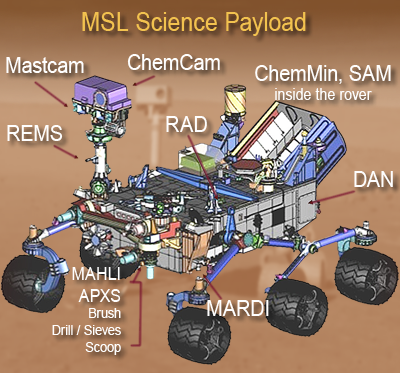
    • Mars Science Laboratory (MSL) Curiosity. Science Payload: The rover carries a complete geological lab for analysis of samples on location. NASA + JPL + Ren@rt, 2011.Mast Camera (Mastcam): Two cameras for stereo imaging mounted on the Remote Sensing Mast: Telephoto, colour and video.
    • Mars Hand Lens Imager (MAHLI): A magnifier tool capable of looking at samples in colour even in the dark using ultraviolet light. This is mounted on the end of the arm.
    • Mars Descent Imager (MARDI): This camera will be activated shortly after the separation from the heat shield. It will take colour High Definition images at 5 frames per second all the way to the surface. After landing it is turned off and remain available in case it is required later. Some of the images acquired will be sent to Earth within the first 2 weeks and in a few months all the images will arrive to create a movie sequence of entry and descent.
  2. Spectrometers
    • Alpha Particle X-Ray Spectrometer (APXS) (in collaboration with Canada): Bombards a sample with Alpha particles or X-Rays to determine its composition.
    • Chemistry & Camera (ChemCam) (in collaboration with France): A 2-piece instrument, one with a telescope. Uses a high power laser from 5m away that vaporizes the outer surface of the rock, then the camera's spectrometer analyses the resulting cloud of plasma to determine its chemical composition, this triage process singles out the interesting rocks to approach for sampling. A similar instrument is used on Earth to detect lead contents of wall paint.
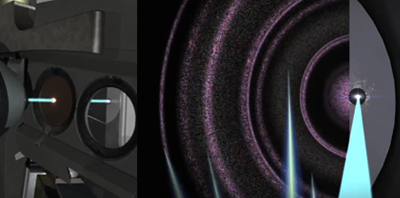
    • Mars Science Laboratory (MSL) Curiosity. ChemCam uses a powerful laser to vaporise rock samples at a distance of up to 5 metres to analyse the spectrum of the resulting plasma. NASA + JPL + Ren@rt, 2011.Chemistry & Mineralogy X-Ray Diffraction/X-Ray Fluorescence Instrument (ChemMin): This is an X-Ray diffraction pattern detector that processes samples to find component minerals. It vibrates the samples to operate.
    • Sample Analysis at Mars (SAM) Instrument Suite: Looks for Organic molecules from collected samples. This will find out if there are traces of past microbial life by searching for chemical isotopes generated by biological processes. It also looks for methane, commonly produced by biological processes rather than chemical ones. This is very sensitive, capable of detecting methane in parts per trillion and can find even methane produced on the other side of the planet. This is the largest instrument on the rover, the size of a microwave oven. The samples are processed in a small oven that heats them up to 1000 degrees, which removes all volatile substances before they are passed to other instruments.
  3. Radiation Detectors
    • Mars Science Laboratory (MSL) Curiosity. Drill mounted on the arm perforates the rock and powdered samples are picked up and fed into the rover body for analysis with ChemMin and SAM. NASA + JPL + Ren@rt, 2011.Radiation Assessment Detector (RAD): A radiation detector with dual purpose: It defines the radiation in the environment at the moment of measurement and calculates long-term patterns for future missions.
    • Dynamic Albedo of Neutrons (DAN) (in collaboration with Russia): Detects sub-surface Hydrogen by bombarding the surface with a neutron generator and looks at reflected neutrons. Its purpose is to find Hydrogen or Water under the surface.
  4. Environmental Sensors
    • Rover Environmental Monitoring Station (REMS) (in collaboration with Spain): A weather station that detects atmospheric pressure, temperature, wind speed and direction and other meteorological measurements that will report back to earth in the future. These are mounted on booms or masts. Includes a UV detector.
  5. Atmospheric Sensors
    • Mars Science Laboratory Entry Descent and Landing Instrument (MEDLI): Determines atmospheric conditions and performance of the MSL during entry.

ChemMin and SAM analyse samples inside the rover
Pulverised samples are fed to a disk-shaped transparent chamber, of which various pairs are ready to rotate into position. The instruments analyse the material using X-Ray diffraction and determine patterns that represent chemical elements.

Mars Science Laboratory (MSL) Curiosity. ChemMin and SAM analyse samples inside the rover using X-Ray diffraction beams to determine their chemical composition. NASA + JPL + Ren@rt, 2011.Mars Science Laboratory (MSL) Curiosity. ChemMin and SAM analyse samples inside the rover using X-Ray diffraction beams to determine their chemical composition. NASA + JPL + Ren@rt, 2011.

Watch the animation from Jet Propulsion Laboratory

Building the Mars Science Laboratory
The MSL Curiosity was built in a clean room at JPL's Spacecraft Assembly Facility. See the engineers wearing white "Bunny suits" to protect the rover from Earthly contaminants.

Curiosity Rover on Mars
In 2012 the Mars Science Laboratory “Curiosity” will rover on Mars, seeking chemical evidence of life and attempting to answer many scientific questions for the advancement of humanity into space.

Mars Science Laboratory (MSL) Curiosity. The rover will explore Mars in late 2012 looking for evidence of life and learning more about the planet. Artistic front view over photo-composite take by Opportunity. NASA + JPL + Ren@rt, 2011.Mars Science Laboratory (MSL) Curiosity. The rover will explore Mars in late 2012 looking for evidence of life and learning more about the planet. Artistic front view over photo-composite take by Opportunity. NASA + JPL + Ren@rt, 2011. Mars Science Laboratory (MSL) Curiosity. The rover will explore Mars in late 2012 looking for evidence of life and learning more about the planet. Artistic side view over photo-composite taken by Pathfinder. NASA + JPL + Ren@rt, 2011.Mars Science Laboratory (MSL) Curiosity. The rover will explore Mars in late 2012 looking for evidence of life and learning more about the planet. Artistic side view over photo-composite taken by Pathfinder. NASA + JPL + Ren@rt, 2011.

Humans on Mars

In preparation to humans visiting Mars, NASA is planning on building capabilities that exceed those achieved by the Apollo programme. They will first send 4 people to the Moon for gradually longer stays, starting with one week and gradually progressing to up to 6 months.

When all the problems about living on an extra-terrestrial environment are solved in a near base like the Moon, which is only 3 days away, the next step will be a manned mission to Mars.

As stated by Richard Gilbrech (Associate Administrator for Exploration System, NASA) in 2008, initial missions to Mars are anticipated to take 3 crew astronauts in a 30 month mission. Starting with a 6 month journey, followed by a required 18 months stay on the surface until the planets align and the mission can embark on a similar length of journey back to Earth.

From this point of view, the International Space Station and the Moon are experiments to build capabilities for longer missions. They will require a global enterprise with immense investments of time, people and money.

On this mission, an unprecedented 1 ton of equipment will be landed on another planet. It is expected that by the time a human mission arrives in Mars, the volume of equipment required to land will have a weight of 40 to 60 tonnes; so far we do not have the technology to handle that weight.

Humans on Mars
Humans will eventually arrive in Mars and expand the horizons of space exploration.

Humans will eventually arrive in Mars. The next step of exploration of our universe. NASA + JPL + Ren@rt, 2011.Humans will eventually arrive in Mars. The next step of exploration of our universe. NASA + JPL + Ren@rt, 2011.

References

¤ ‘The Moon and Mars - the next destinations for humans’ (2008). The 59th International Astronautical Congress, Glasgow, Scotland. [Online]. Available here. (Accessed: 06 November 2011).
¤ ‘Curiosity Rover, FAQ’ (2011). JPL. [Online]. Available here. (Accessed: 06 November 2011).
¤ Richard Cook ‘Mars Science Lab Curiosity’ (2011). Theodore von Karman Lecture Series at JPL. [Online]. Available here. (Accessed: 06 November 2011).
¤ ‘Mars Science Laboratory Curiosity Rover Animation’ (2011). JPL. [Online]. Available here. (Accessed: 07 November 2011).
¤ ‘Mars Science Laboratory Lifts Off for Red Planet’ (2011). JPL. [Online]. Available here. (Accessed: 27 November 2011).
¤ ‘MSL's Mars Trajectory Confirmed During Post-Launch Briefing’ (2011). JPL. [Online]. Available here. (Accessed: 27 November 2011).
¤ ‘MSL Atlas Launch MECO + Separation NASATV HD mars 11/26/2011’ (2011). JPL. [Online]. Available here. (Accessed: 27 November 2011).
¤ Vasavada, A (2011). ‘Mars Rover Power’ JPLnews. [Online]. Available here. (Accessed: 16 November 2011).
¤ ‘JPL Rovers’ (2011). JPL. [Online]. Available here. (Accessed: 06 November 2011).
¤ ‘Animation improvements’ (2011). Aniden. [Online]. Available here. (Accessed: 06 November 2011).

Images

¤ All images edited by ren@rt. Source: JPL, NASA.