Showing posts with label landing. Show all posts

Tuesday, 9 March 2021

Perseverance Landed on Mars - 18 Feb 2021

We landed on Mars!

Congratulations Mars 2020 Perseverance Rover Team!

Perseverance successfully landed on Mars on 18 Feb 2021, after travelling 497 km from Earth on a 213-day journey (departed on 30 July 2020).

Entry Descent and Landing (EDL) highlights

The Engineering team at NASA/JPL had a sequence of 38 events lined up for EDL, which started with the separation from the Cruise Stage that took the rover from Earth to Mars.

Shortly before entry into the atmosphere, the spacecraft was at an altitude of 134km from the surface and travelling at 5.3 km/s and carrying 400 kg of fuel.
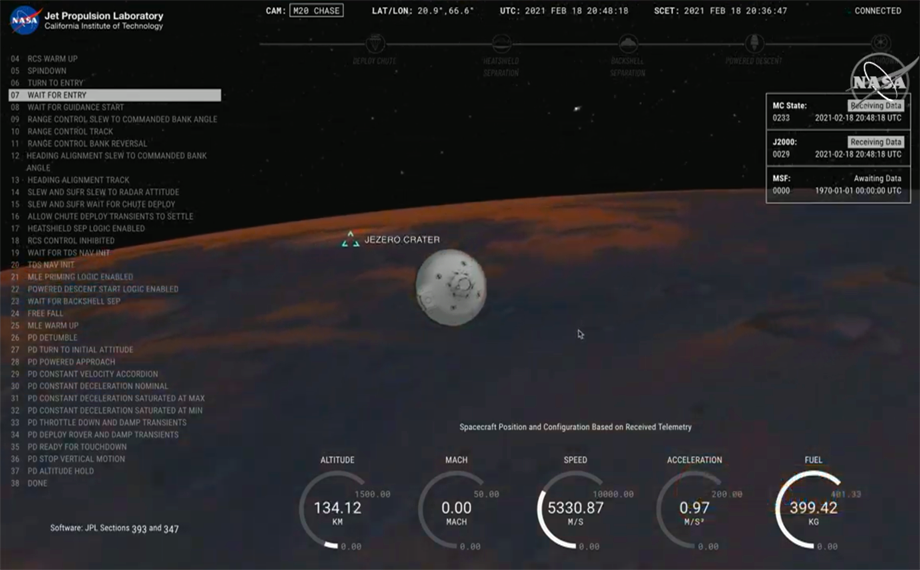
Perseverance spacecraft prepares to enter the Martian atmosphere. NASA/JPL, 2021. Perseverance spacecraft prepares to enter the Martian atmosphere. NASA/JPL, 2021.

Entering the atmosphere, Perseverance had to go through a rapidly increasing density of air particles. Her heat shield (4.5 m in diameter) protected the rover from friction against those particles, which produced temperatures of over 1,300 C. Once inside the atmosphere, the spacecraft was able to adjust her trajectory of fall using thrusters to aim for the target landing zone; when everything looked promising, at an altitude of 11 km and still falling faster than the speed of sound at Mach 1.23 (286 m/s or 1,030 km/h), she deployed her parachute, the largest ever built for space (at 21.5 m in diameter).

Mach 1 is a flow velocity value that equals the speed of sound, which due to the low Martian surface temperature (average -63 C) is 244 metres per second (m/s) or 878 km/h; this is roughly 100 m slower than the speed of sound on Earth (343 m/s).

Perseverance spacecraft deploys its supersonic parachute. NASA/JPL, 2021. Perseverance spacecraft deploys its supersonic parachute. NASA/JPL, 2021.

The parachute slowed down the spacecraft drastically to a speed of less than 90 m/s, creating a gravitational force of 11 g.

While still on target, Perseverance was spotted by the Mars Recognisance Orbiter and took a picture as she approached the Jezero crater.

Perseverance on a parachute approaching Jezero crater. Picture from the Mars Recognisance Orbiter, NASA/JPL, 2021. Perseverance on a parachute approaching Jezero crater. Picture from the Mars Recognisance Orbiter, NASA/JPL, 2021.

Hanging from the parachute, the first images taken by the up-looking camera of the Back Shell show the canopy (made of polyester and nylon) fully inflated against the clear sky of a sunny Martian day.

The top vent is a hole in the centre of the parachute that controls for rocking movements. The 48 suspension lines converge in the swivel that links them to three tethers or Triple Bridle made of Kevlar, an extremely resistant material used for bullet-proof vests. The triple bridal that connects the parachute to the back shell was designed to hold an inflation load of 8.1-8.6 tonnes (80,100 - 84,600 Newtons [N]), which is close to the expected force created by the falling weight of the spacecraft (about 1 tonne) and the speed of fall.

Note: A Newton is the unit of force required to accelerate a mass of one kilogram one metre per second.

Supersonic parachute slowing down the fall of Perseverance. Picture taken by the up-looking Parachute Cam on top of the Back Shell. NASA/JPL, 2021. Supersonic parachute slowing down the fall of Perseverance. Picture taken by the up-looking Parachute Cam on top of the Back Shell. NASA/JPL, 2021.

Once the parachute had slowed down the fall sufficiently, the lander separated from the Back Shell by sliding down a metal tape to take position at the end of a 20-metre long bridle made of Zylon (a material similar to Kevlar braided in a webbing pattern like those used for sailing), this provided enough distance for the Descent Stage solid rocket motors exhaust stream. When the parachute was no longer needed, the Descent Stage thrusters fired and the Back Shell was released, switching to powered controlled descent.

Shortly after, the Rover extended her wheels and was slowly lowered by a crane operation onto the ground. The Descent Stage camera took images of dust being blown away by the thrusters as Perseverance approached the Martian surface.

Perseverance rover lowered down on cables from the Descent Stage. NASA/JPL, 2021.

A close-up of the rover shows that all parts were still in place and ready for touch-down.

Close up of Perseverance from the Descent Stage look-down camera. NASA/JPL, 2021.

Landing site

Planning the landing site for the rover was limited by the moderate resolution of the reference images taken by the spacecraft orbiting around Mars. The final selection of the landing spot had to be done by the rover’s software based on the analysis of photographic and radar data obtained during the rapid descent.

Altitude range: Colours in kilometres.

The next images show the location of the Jezero crater on the north-east edge of the Isidis Basin or Planitia. The colours illustrate altitude levels relative to the green areas, which represent zero altitude. Blue areas are lower, while yellow and red zones are raised.

The Jezero crater has a delta (a raised area coloured in purple) near its northern rim, which corresponds to a canyon that once was a river.
Read more at Persevere to Succeed.
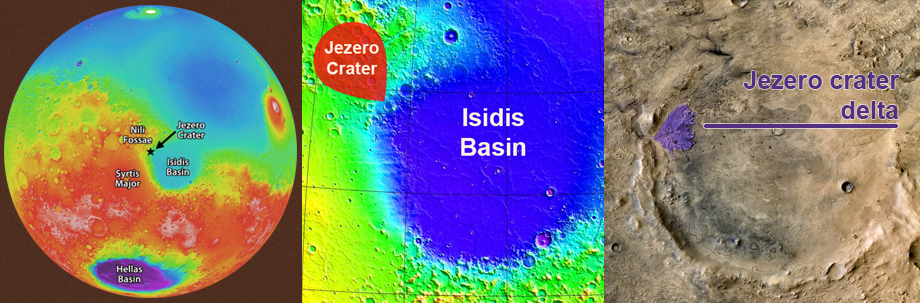
Mars and the location of the Isidis Basin, the Jezero crater and its delta. NASA/JPL, 2020. Mars and the location of the Isidis Basin, the Jezero crater and its delta. NASA/JPL, 2020.

In an image taken by the Mars Reconnaissance Orbiter, the large elevated delta inside Jezero crater is visible at the top. A flat, depression separates the edge of the delta from the Canyon De Chelly (named after the national monument in Arizona, USA and pronounced “de-shay”, a word derived from the Navajo [Tséyi], meaning “inside the rock” or “canyon”, and borrowed to the Spanish “Chelly”, then adapted to English with a French-like pronunciation), near the final landing spot, approximately 2 km southeast.
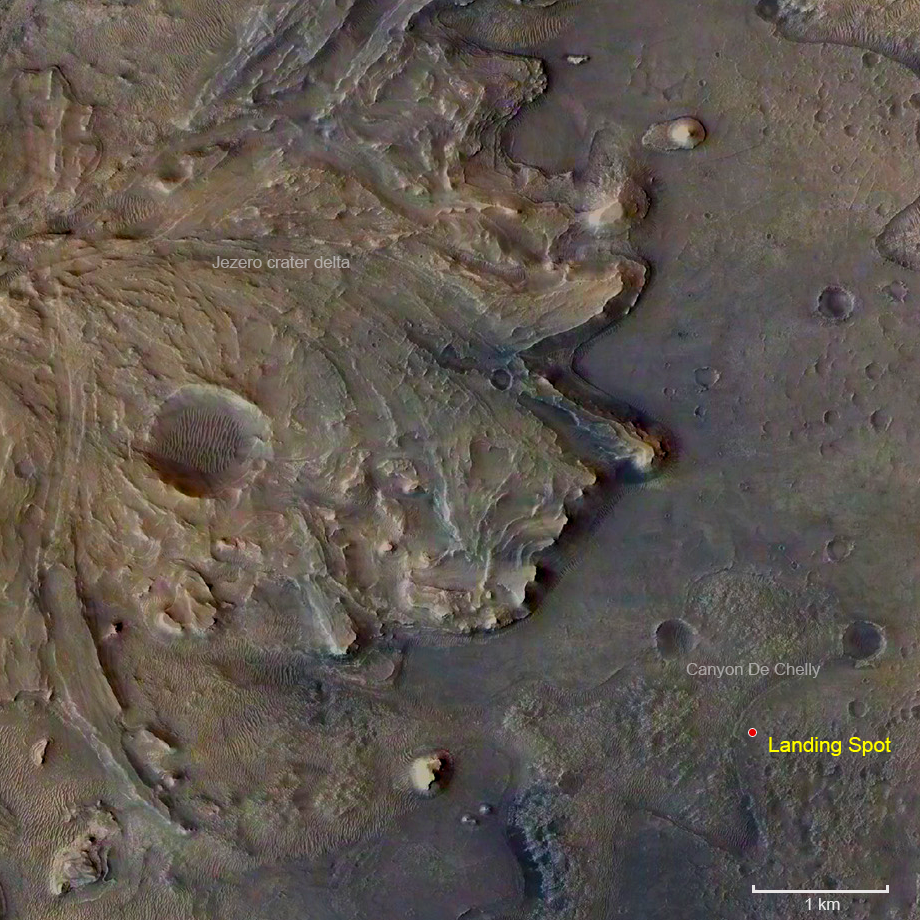
Perseverance’s landing spot inside the Jezero crater, southeast of the delta. Mars Reconnaissance Orbiter. NASA/JPL, 2021. Perseverance’s landing spot inside the Jezero crater, southeast of the delta. Mars Reconnaissance Orbiter. NASA/JPL, 2021.

Satellite pictures of the planned landing area were previously analysed and a mapped by geologic units, which refer to the smoothness or roughness of the surface. The landing spot is within an ideal smooth unit, surrounded by a fractured unit and a fractured rough unit.

Jezero crater’s geologic units showing the landing spot in a smooth unit, NASA/JPL, 2021. Jezero crater’s geologic units showing the landing spot in a smooth unit, NASA/JPL, 2021.

A photograph taken by the Rover down-looking camera shows the heat shield separating. In the background is the bottom of the Jezero crater as seen by the rover with the final landing spot marked for reference.
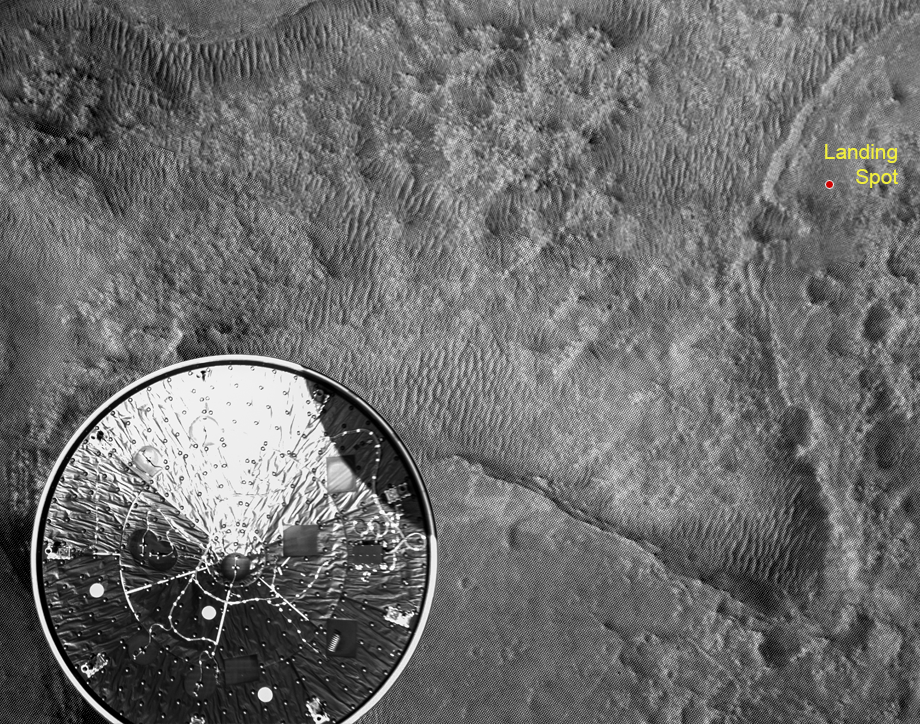
Heat Shield separation and Jezero crater with the targeted landing spot. Perseverance rover, NASA/JPL, 18 Feb 2021. Heat Shield separation and Jezero crater with the targeted landing spot. Perseverance rover, NASA/JPL, 18 Feb 2021.

Closer to the surface, the rover took more pictures used to aim at the safest landing spot, flat and smooth, with the least amount of irregularities that may obstruct the rover’s functions and movement but also close to interesting features that she will explore during the mission.

Jezero crater, closer view and spotted landing site. Perseverance rover, NASA/JPL, 18 Feb 2021. Jezero crater, closer view and spotted landing site. Perseverance rover, NASA/JPL, 18 Feb 2021.

Heat Shield in free-fall over Jezero crater’s delta.

Heat Shield in free-fall over Jezero crater, Mars. NASA/JPL, 18 Feb 2021. Heat Shield in free-fall over Jezero crater, Mars. NASA/JPL, 18 Feb 2021.

Touchdown!

As soon as Perseverance touched the ground, she cut off the cables that connected her to the Descent Stage, which flew away to a distant and safe place crashing on the terrain when it run out of fuel.

Photographs taken by the rover’s up-looking camera show the Descent Stage during the Crane operation and as it flies away in a cloud of dust produced by its thrusters as it gently place the rover on the ground.
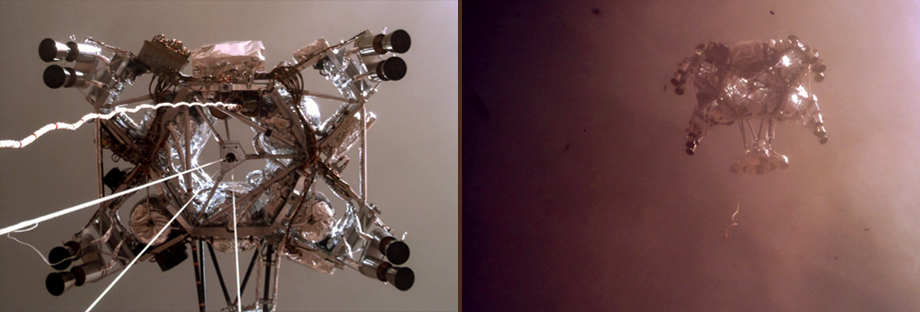
Descent Stage. Photograph taken by the Rover’s up-looking camera as it was being craned down and as it flew away. NASA/JPL, 18 Feb 2021. Descent Stage. Photograph taken by the Rover’s up-looking camera as it was being craned down and as it flew away. NASA/JPL, 18 Feb 2021.

Touchdown celebrations

The teams of specialist at the Mars 2020 Perseverance control rooms at NASA/JPL were nervously monitoring every moment of the agonising seven minutes of Entry, Descent and Landing (EDL). EDL may be calculated, planned and computer-simulated but cannot be tested on Earth. There is only one chance for it to either be successful or fail and that happens on the surface of Mars.

The tension of the countdown to touchdown peaked when it was announced “Touchdown Confirmed!” The control room exploded into celebratory growls, cheering, clapping and sighs of relief for a magnificent achievement. All went according to plan.
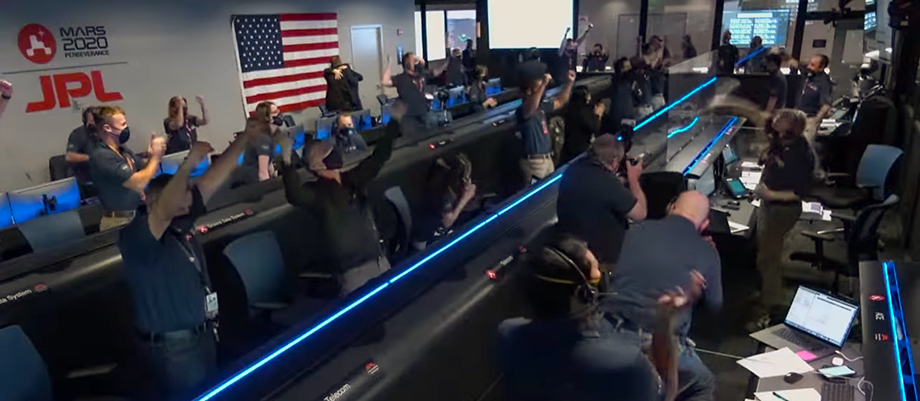
Celebrations at the NASA/JPL control room after the announcement of touchdown. NASA/JPL, 18 Feb 2021. Celebrations at the NASA/JPL control room after the announcement of touchdown. NASA/JPL, 18 Feb 2021.

The event was broadcast live on NASA’s YouTube Channel and viewed by millions around the world.

Raquel Villanueva, the host of the show, introduced the project and presented interviews with representatives from the administration, management, engineering and other teams; this included Steve Jurczyk, Acting NASA Administrator. Co-host Marina Jurica, presented interviews with the scientific team and special guest from the public.

Sample of participants in the live broadcast of Perseverance landing via YouTube on 18 February 2021.NASA, YouTube, 18 Feb 2021. Sample of participants in the live broadcast of Perseverance landing via YouTube on 18 February 2021.NASA, YouTube, 18 Feb 2021.

First images from Mars

Because Mars is 204 million kilometres away, it takes 11 minutes for data to arrive to Earth, despite travelling at the speed of light. Everything we know about the landing has happened at least 11 minutes ago! The round-trip for signals sent and returning from the rover take at a minimum 22 minutes, a lagging phenomenon known as “2-way light-time”.

The first tangible proof of success were the first images of Mars taken by Perseverance, using the engineering navigation cameras (NavCams), which point to the ground in front of the wheels.

First pictures sent by Perseverance from Mars arrived on 18 February 2021. NASA/JPL, 18 Feb 2021. First pictures sent by Perseverance from Mars arrived on 18 February 2021. NASA/JPL, 18 Feb 2021.

Vast amounts of dust were stirred up and blown away by the thrusters propelling the Descent Stage as it hovered at an altitude of 21 metres to drop down the rover; the first images were blurry and distorted due to the transparent shield protecting the Navcams from the dust. Once the dust had settled, the lens shields came off and better-quality pictures were taken.

Cleaner pictures of the landing zone on Mars, taken by the right and left Navcams on board the rover. NASA/JPL, 18 Feb 2021. Cleaner pictures of the landing zone on Mars, taken by the right and left Navcams on board the rover. NASA/JPL, 18 Feb 2021.

Mars 2020 Perseverance Rover mission begins

Perseverance landed on the surface of Mars with her back facing the delta, which was north-west to her; her front was facing southeast, pointing at the Isidis Basin or Planitia. The site was almost flat, with an inclination of one degree. Part of the natural dust covering the rocks was dispersed by the blast of the Descent Stage’s thrusters, uncovering features on their surface.

The images taken by the Navcams show rocks with small holes all over their surface which on Earth may suggest a volcanic origin, like pumice rock with holes (vesicles) on its surface. Sedimentary rock might also develop holes when parts of their components dissolve in water, leaving holes on the surface. The material on the surface is likely to be a few billion years younger than the Jezero Crater, which is thought to have formed around 3.9 billion years ago.

The small holes on the surface of rocks resemble those found on rocks brought from our Moon, which are thought to be the result from air bubbles trapped in lava.

A rock sample brought from our Moon in 1960s shows a surface similar to those seen on Mars. NASA/JPL, 18 Feb 2021. A rock sample brought from our Moon in 1960s shows a surface similar to those seen on Mars. NASA/JPL, 18 Feb 2021.

At a high-resolution, the holes on the rocks seem to have sharp edges with some evidence of friction, or erosion as it occurs in fluvial deposits (exposed to flowing liquid and sand).

A closer look at surface rocks on Mars next to the rover’s wheel. Picture by SuperCam, NASA/JPL, 22 Feb 2021. A closer look at surface rocks on Mars next to the rover’s wheel. Picture by SuperCam, NASA/JPL, 22 Feb 2021.

Although all activities carried-out on the surface of Mars are pre-sequenced and scripted, Perseverance can adjust to local conditions to fulfil those commands. Confident on this ability, operators at the control room at NASA/JPL send commands to the rover once a day.

One of the first commands sent to the rover was to verify her status of health, checking her instruments and the function of the main and the backup computers. This process took four days and was essential before the start of the surface mission.

Satisfied that the rover’s software was in good form, the mast was raised, and the high-resolution cameras began taking pictures. The first images were of the rover’s body and parts to verify that everything was in place and looking healthy.

Details of the surface of the rover taken by the SuperCam. NASA/JPL, 22 Feb 2021. Details of the surface of the rover taken by SuperCam. NASA/JPL, 22 Feb 2021.

SuperCam was used at its best to take pictures of the rover’s surroundings. Those images were joined together to create a 360-degree high-resolution panorama of the Jezero crater.

360-degree panorama of Jezero crater, taken by SuperCam. NASA/JPL, 25 Feb 2021. 360-degree panorama of Jezero crater, taken by SuperCam. NASA/JPL, 25 Feb 2021.

The hilltops at the distance correspond to the raised edges of the delta and the Jezero crater (green area below).

A section of the 360-degree panorama of Jezero crater showing the delta. Photo by SuperCam. NASA/JPL, 25 Feb 2021. A section of the 360-degree panorama of Jezero crater showing the delta. Photo by SuperCam. NASA/JPL, 25 Feb 2021.

A closer look at the rock formation in front of the hills of the Jezero delta at the top of the previous picture gives us an example of the imaging capabilities of the SuperCam (yellow area below).

Closeup of rock formation rising in front of the Jezero delta. Photo bySuperCam. NASA/JPL, 25 Feb 2021. Closeup of rock formation rising in front of the Jezero delta. Photo by SuperCam. NASA/JPL, 25 Feb 2021.

At full resolution, the details and depth separation between the boulders, the rock formation and the mountains in the background are more evident (orange area below).
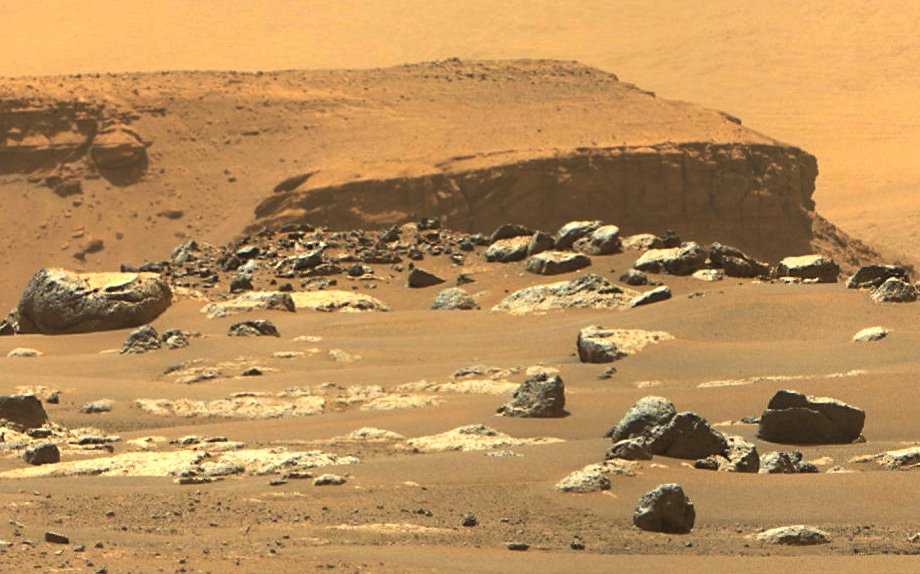
Full-resolution extreme-closeup of boulder in front of the Jezero delta. Photo by SuperCam. NASA/JPL, 25 Feb 2021. Full-resolution extreme-closeup of boulders in front of the rock formation. Photo by SuperCam. NASA/JPL, 25 Feb 2021.

The image below shows the approximate angles covered by the pictures above: The portion of the panorama in green; a closer look at the rock formation in yellow and a full-resolution closeup in orange.

Forming the horizon in the pictures above, the north-east edge of the Jezero crater appears as a large mountain range and a slightly taller mountain separated by a valley, which corresponds to the canyon that once was the inlet river and appears on the left side of the picture below.

CJezero crater’s delta and inlet valley. Approximate angles of coverage of the pictures above from Perseverance’s landing spot. Mars Reconnaissance Orbiter, NASA/JPL, 2020. Jezero crater’s delta and inlet valley. Approximate angles of coverage of the pictures above from Perseverance’s landing spot. Mars Reconnaissance Orbiter, NASA/JPL, 2020.

On 5th March 2021, the landing site was given a name: “Octavia E. Buttler Landing” after an award-winning sci-fi writer from California, USA.
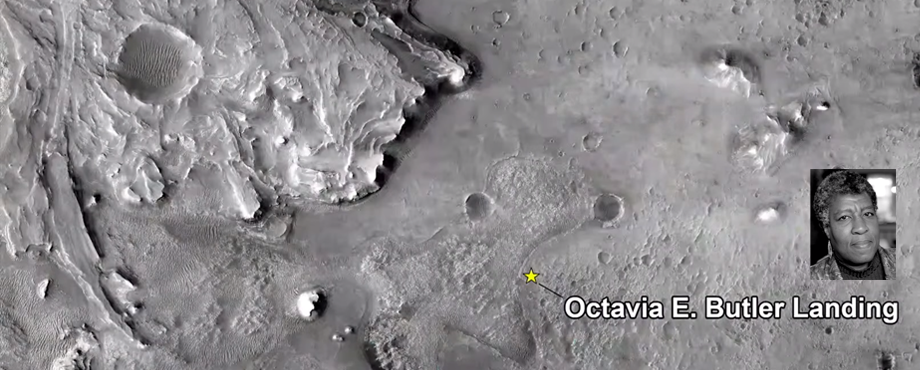
Perseverance landing site named after sci-fi writer Octavia E. Buttler. NASA/JPL, 05 Mar 2021. Perseverance landing site named after sci-fi writer Octavia E. Buttler. NASA/JPL, 05 Mar 2021.

All systems, Go!

In the first three days after landing the Surface Mission Team executed more than 5,000 commands to check the health status of the rover. All systems were working well, including the Flight Software Update, which is essential to release all the available capabilities of the rover to perform her surface mission. The software is small at 16MB but able to run 140 tasks simultaneously and has been developed in many years and tested on previous rovers.

Top view of Perseverance rover, sol 13. Photo by SuperCam. NASA/JPL, 25 Feb 2021. Top view of Perseverance rover, sol 13. Photo by SuperCam. NASA/JPL, 25 Feb 2021.

On 4th March 2021, the rover took her first drive. Her six wheels have independent motors for traction, steering is done with the front and rear wheels, while the centre wheels are for support. The suspension keeps the rover high and allows the wheels to drive over obstacles as high as the diameter of a wheel. Although the standard speed is about 150m/h (0.1 km/h), the rover can drive faster, up to 0.8 km/h.
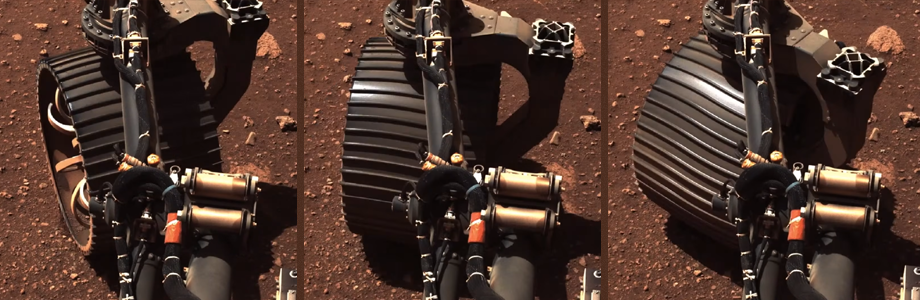
Tests of rotation of Perseverance’s front wheels. NASA/JPL, 04 Mar 2021. Tests of rotation of Perseverance’s front wheels. NASA/JPL, 04 Mar 2021.

Wheel tracks showing the first run of Perseverance on Martian soil. NASA/JPL, 04 Mar 2021. Wheel tracks showing the first run of Perseverance on Martian soil. NASA/JPL, 04 Mar 2021.

Videos from Mars

In those few days, Perseverance sent over 30 Gigabytes of information and over 23,000 images, this included the first ever videos of Descent and Landing, thanks to cameras on top of the Back Shell, below the Descent Stage and above and below the Rover. The cameras took video at 75 frames per second, which allows viewing in smooth slow motion to appreciate and study every detail from different points of view.

NASA’s video of Perseverance Rover’s Descent and Touchdown on Mars. 3.25 min. NASA/JPL, 22 Feb 2021.


REFERENCES

(Links open in a new tab or window depending on your browser’s settings.)

1. » NASA (2021) What’s Next for Perseverance Mars Rover? Sol 1 Press Conference. 21 Feb. 2021 [Online video]. Available here. (Accessed: 19 Feb 2021).
2. » Wikipedia (2021) Mach number. [Online page]. Available here. (Accessed: 19 Feb 2021).
3. » Clark S (2021) What to expect during Perseverance’s landing on Mars. Spaceflight now, 18 February 2021. [Online page]. Available here. (Accessed: 19 Feb 2021).
4. » NASA (2021) Mars Perseverance RAW images. [Online page]. Available here. (Accessed: 23 Feb 2021).
5. » NASA-JPL (2020) Spacecraft: Parachute. [Online page]. Available here. (Accessed: 24 Feb 2021).
6. » Woodford C (2021) Parachutes. Explainthatstuff.com. [Online page]. Available here. (Accessed: 24 Feb 2021).
7. » NASA-JPL (2021) Perseverance's Landing Spot in Jezero Crater. [Online page]. Available here. (Accessed: 25 Feb 2021).
8. » Wikipedia (2021) Canyon de Chelly National Monument. [Online page]. Available here. (Accessed: 26 Feb 2021).
9. » NASA-JPL (2021) Landing broadcast: Perseverance Rover Lands on Mars. Hosted by Raquel Villanueva. [Online video]. Available here. (Accessed: 26 Feb 2021).
10. » NASA (2020) Virginia Middle School Student Earns Honor of Naming NASA's Next Mars Rover. [Online page]. Available here. (Accessed: 27 Feb 2021).
11. » NASA-JPL (2021) NASA’s Perseverance Rover Gives High-Definition Panoramic View of Landing Site. [Online page]. Available here. (Accessed: 26 Feb 2021).
12. » NASA-JPL (2021) NASA's Perseverance Rover Sends New Video and Images of the Red Planet – 22 Feb 2021. [Online video]. Available here. (Accessed: 04 Mar 2021).

Wednesday, 17 February 2021

Countdown to Touchdown on Mars

Entry, Descent and Landing of  Perseverance Rover on 18 February 2021.

After launching from Earth at the end of July 2020, it took Perseverance six months to get to Mars and it will take her seven minutes to enter the atmosphere and land on the surface. The performance of the spacecraft in those crucial last minutes will make or break the mission (at a cost of $2.9 billion).

NASA’s Mars 2020 Perseverance Rover will land on Mars this Thursday 18 February 2021.

Entry, descent and landing - The Countdown:

Entry, Descent and Landing. NASA/JPL, 2020.

16 min: Travelling at a speed of 17,000 km/h and at an altitude of 1,600 km, the Cruise stage will separate from the rover, which will be spinning for an extra minute.
15 min: Two 70kg balancing masses will be ejected and spinning will be under control.
10 min: Travelling at 18,000 km/h, the rover will be at 500 km from the surface but still 1,600 km from the landing site.
7 min (8:48pm on 18 Feb 2021): Travelling at 19,000 km/h at an altitude of 132 km and 640 km from the landing side, the spacecraft will reach the Entry Interface Point, penetrating the Martian atmosphere.
6 min: At an altitude of 52km, 322 km from the landing site, the spacecraft will fire compensatory thrusts to adjust its direction as it encounters uneven concentrations of gasses during the Guidance phase. Friction against an increasing concentration of gas particles in the atmosphere will drastically slow dawn the fall and generate immense amounts of heat. The rover will be protected by its Heat Shield, which will glow orange from the heat.
5 min: At an altitude of 17 km, 123 km from the landing site, the speed will be 7,400 km/h. The spacecraft will continue to adjust its direction before entering the Heading Alignment phase.
4 min: At an altitude of 16 km, 50 km from the landing site, the speed will be 2,500 km/h and the Heat Shield will start to cool down. Jezero crater, the spacecraft’s target, will be in sight.
3 min: At an altitude of 13 km and 21 km from the landing site, the speed will be 1,700 km/h as the spacecraft begins the Straight Up and Fly Right (SURF) manoeuvre. Six balance masses will be ejected, and thrusters will adjust the angle of attack to zero.
2:45 min: At an altitude of 11 km and 14 km from the landing site, with a speed of 1,500 km/h, the spacecraft will calculate the correct distance to its target and deploy its Parachute in an operation known as Range Trigger.
2:26 min: At an altitude of 9 km and 10 km from its destination, the speed will be 600 km/h. While the spacecraft is still suspended from its parachute, the Heat Shield will separate from the bottom, exposing the rover and the Rover Cameras to the Martian terrain.
1:25 min: At an altitude of 4 km and still 4 km away from the landing site, the speed will be 300 km/h and the acquisition of Terrain Relative Navigation (TRN) images will begin. Those pictures will help the onboard computer correct the trajectory of the spacecraft in seconds to guide it towards a safe landing zone.
1 min: At an altitude of 2 km and 2 km from the now decided target, the speed will be just below 300 km/h when the Descent Stage will separate from its Back Shell and Parachute and begin rocket-powered propulsion to control its vertical and horizontal speeds.
30 sec: At an altitude of 300 m and 300 m from the landing site, the speed will be 120 km/h as the rover keeps approaching the surface in controlled flight.
18 sec: At an altitude of 22 m over the landing site, the speed will be controlled at 11 km/h as the Descent Stage starts throttling down to hover over the surface.
16 sec: At an altitude of 21 m the velocity will be at its lowest (2.7 km/h) as the Descend Stage begins Rover Separation.
13 sec: At 13 m of altitude the speed will be 9 km/h as the Rover is lowered on a set of cables in a crane-like operation. As this happens, the Rover will deploy its wheels.
10 sec: At an altitude of 8 m, the velocity will be 4 km/h and the Rover will prepare to contact the surface.
0 sec (8.55pm on 18 Feb 2021): Touch down on Mars. When the Rover senses that the wheels have touched the ground, it will cut the cables and the Descent Stage will fly away until it expends all its remaining fuel and crashes into the terrain.
+ 10 seconds after landing: Surface Operations will begin.

The Perseverance Rover is an astrobiological mission, searching for signs of life in Mars. Find more about the rover and the mission in our previous post “Persevere to Succeed ”.


Entry, Descent and Landing of Perseverance Rover on Mars on 18 February 2021. NASA/JPL, 2020.

Entry, Descent and Landing of Perseverance Rover on Mars on 18 February 2021. NASA/JPL, 2020.


Perseverance will not be alone


Tianwen-1 (TW-1) Orbiter and Rover. China National Space Administration (CNSA), 2020.

The China National Space Administration (CNSA) launched the “Tianwen-1 (TW-1)” mission on 23 July 2020 and entered Mars’ orbit on 10 February 2021.

During one Martian year (two Earth years), the orbiter of this mission will study the atmosphere (climate, seasons, environment) and the upper region which is ionised by solar radiation (ionosphere), it will also study the composition of rocks, mineral content and weathering minerals looking for characteristics of water and ice distribution and evidence of life. It will also study electromagnetic and gravitational fields, and the internal structure of Mars. There are 13 scientific projects onboard the orbiter.

The orbiter’s instruments include: The Mars-Orbiting Subsurface Exploration Radar, Mars Mineralogy Spectrometer, Mars Magnetometer, Mars Ion and Neutral Particle Analyzer, and Mars Energetic Particle Analyzer.

The orbiter carries a 250-kg Rover that will land on the Utopia Planitia in April or May 2021; the rover’s mission will last 90 Martian days (sols), during which it will collect samples to be retrieved by future missions.

The rover carries: The Multispectral Camera, Terrain Camera, Mars-Rover Subsurface Exploration Radar, Mars Surface Composition Detector, Mars Magnetic Field Detector, and Mars Meteorology Monitor.


This is a Space Race

Mars Hope and its first picture of Mars, taken by the orbiter on 14 February 2021. United Arab Emirates Space Agency (UAESA), 2021.

The United Arab Emirates Space Agency (UAESA) launched the “Mars Hope” mission on 19 July 2020 and arrived at Mars on 09 February 2021 entering orbit successfully. The following day it took the first picture of Mars at an altitude of 24,700 km from the surface (The image on the right shows a model of Mars Hope over the picture of Mars taken by the orbiter on Wednesday 10 February 2021).

This mission will orbit the planet to create a holistic diurnal picture of Mars’ atmosphere.


REFERENCES

(Links open in a new tab or window depending on your browser's settings.)

» NASA (2020) Entry, descent and landing. [Online page]. Available here. (Accessed: 16 Feb 2021).
» NASA (2021) 7 Minutes to Mars: NASA's Perseverance Rover Attempts Most Dangerous Landing Yet. [Online video]. Available here. (Accessed: 17 Feb 2021).
» Wan, W.X., Wang, C., Li, C.L. et al. (2020) China’s first mission to Mars. Nat Astron 4, 721. DOI: 10.1038/s41550-020-1148-6. [Journal article]. Available here. (Accessed: 16 Feb 2021).
» Wall M (2020) China launches ambitious Tianwen-1 Mars rover mission. [Online article]. Available here. (Accessed: 16 Feb 2021).
» Arab News (2021) UAE’s ‘Hope’ probe sends home first image of Mars. 14 February 2021. [Online article]. Available here. (Accessed: 16 Feb 2021).
» Guessoum N (2021) How the UAE’s Mars mission can be the Arab world’s springboard to the future. Arab News, 14 February 2021. [Online article]. Available here. (Accessed: 16 Feb 2021).

Friday, 12 February 2021

Persevere to succeed

Title: NASA's Rover Perseverance arrives at mars on 18 February 2021.

NASA’s Mars 2020 Perseverance Rover was launched on board the United Launch Alliance's Atlas V rocket from Kennedy Space Centre in Florida on 30 July 2020. It will arrive at Mars on 18 February 2021.

Perseverance is the 5th rover sent by NASA which started with Spirit and Opportunity rovers that looked for water, the Curiosity rover looking for habitable environment and now Perseverance, looking for signs of life where it is most promising.

Jezero Crater in the Isidis Planitia on Mars, Topographic map. NASA/JPL.

Landing Location

The rover will land on the Jezero crater, found at the north-west edge of the Isidis Planitia. This flat depression is located on the eastern hemisphere of Mars, between the Syrtis Major and Utopia Planitia. The Jezero crater shows a high potential of containing remnants of fossilised microbial life, if it was ever present on the planet, in comparison to more than 60 other candidate landing sites studied over the last five years.

The Isidis Planitia was formed billions of years ago after a large meteorite impacted Mars leaving a 1,325 km-wide crater. Smaller meteorites impacted this flat region (planitia) later forming multiple craters, one of them being the 45km-wide Jezero crater. On closer look, its features suggest that when there was water on Mars, a large river carved a canyon that opened into the crater which was then a lake and had a draining river exiting from the opposite rim. When water evaporated from the planet in progressively drier seasons at around 3.5 billion years ago, a sedimental delta was formed at the mouth of the inlet river, where minerals and perhaps microbial life would have slowly deposited, compacted and fossilised.

Spectrometric studies of images taken by NASA's Mars Reconnaissance Orbiter (MRO) and the High Resolution Stereo Camera aboard the European Space Agency (ESA) Mars Express orbiter, showed signs of minerals possibly altered by water in the past, containing sediments like clays (a combination of silica, alumina, magnesium and other minerals in water) and carbonates (inorganic salts of carbon compounds, sodium and calcium).


Jezero Crater: Images from the High Resolution Stereo Camera aboard the European Space Agency (ESA) Mars Express orbiter, colourised through spectrometry to depict variations in soil composition. NASA/JPL, 2020. Jezero Crater: Images from the High Resolution Stereo Camera aboard the European Space Agency (ESA) Mars Express orbiter, colourised through spectrometry to depict variations in soil composition. NASA/JPL, 2020.

Astrobiology

A Scientific Rover

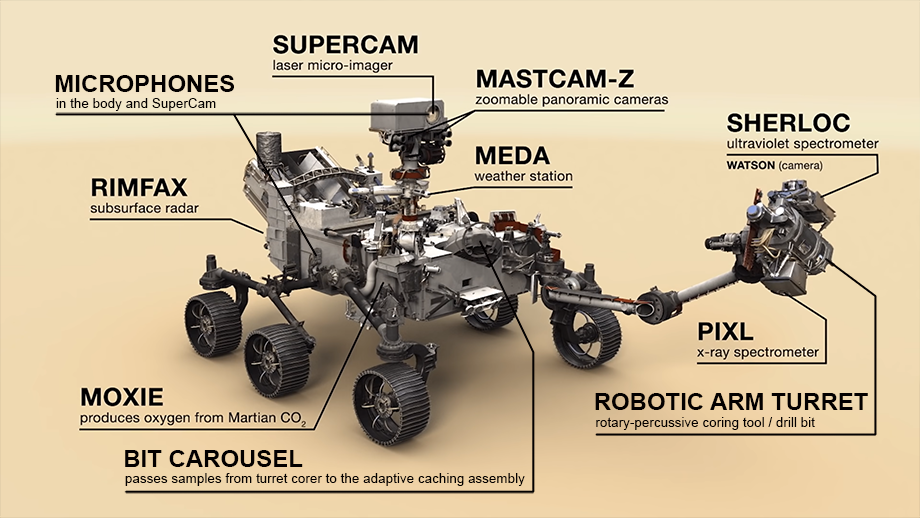
The main purpose of the Perseverance Rover mission is astrobiological investigation. The collection of evidence in the search for bio-signatures to address the question of whether life ever existed on Mars. With this purpose, the rover is equipped with an array of instruments carefully packed into the rover’s body (3m long, 2.7m wide, 2.2m tall, weighting 1.025kg). Additional goals include: Characterisation of climate, geology and preparation for human exploration.
This is the first of a series of missions that will culminate in bringing Martian soil samples to Earth for analysis by 2031.

Instruments:

Perseverance has 7 primary instruments developed by international partner teams (country in parenthesis).

  1. Mastcam-Z (USA): These are high resolution zoomable panoramic stereo cameras for 3D video and still images, located on the Remote Sensing Mast or head or the rover. These cameras will help scientist study the geology by colour analysis and will help operators on Earth decide where to place the robotic arm to carry out its activities.
  2. Mars Environmental Dynamics Analyzer (MEDA) (Spain): This is a weather monitoring station with sensors near the mast and body to measure wind speed and direction, air pressure, humidity, temperature and solar radiation; it has a SkyCam that points at the sky to study clouds, dust and ice.
  3. Mars Oxygen ISRU Experiment (MOXIE) (USA): This instrument produces Oxygen (O2) from Martian Carbon Dioxide (CO2), or “In situ resource utilisation (ISRU)”. Oxygen is essential to ignite the fuel of future rockets launching from Mars. If this prototype works (a 17kg instrument produces 10g of O2 per hour), it will need to be expanded at least 200 times to produce oxygen for human missions and much more to generate the tens of metric tons of liquid oxygen required for a rocket launch.
  4. Planetary Instrument for X-ray Lithochemistry (PIXL) (USA): This X-ray spectrometer located in the turret of the robotic arm. The instrument emits a beam of X-ray at a nearby rock to determine its chemistry by analysing of how it glows or fluoresces. It can detect over 20 chemical elements with high accuracy in 10 seconds and has 6 motorised legs for precise positioning.
  5. Radar Imager for Mars’ Subsurface Experiment (RIMFAX) (Norway): This is a subsurface radar located on the underside of the body of the rover. This ground-penetrating radar has higher resolution then those mounted on orbiting spacecrafts and will help study qualities of the layers deposited on the Martian surface over time, including water ice.
  6. Scanning Habitable Environments with Raman & Luminescence for Organic Chemicals (SHERLOC) (USA): This is an ultraviolet spectrometer, located on the turret of the robotic arm. It flashes ultraviolet laser light over the surface and analyses the glow in search of organic molecules and minerals. It also has a camera to take microscopic images of rock and other surfaces. In addition, it features the Wide-Angle Topographic Sensor for Operations and eNgineering (WATSON) camera.
  7. SuperCam (USA, Spain & France): This is a laser micro-imager for distant analysis of rock, located on top of the mast. It shoots a pulsed laser that heats-up the rock instantly to 10,000 Celsius to create a Spark. The instrument analyses the plasma generated by the spark to determine the chemistry of the rock and with its microphone, it studies the popping sound produced by the spark to characterise its physical properties. It can reach samples up to 7m away from the rover.

Instruments on the Perseverance Rover. NASA/JPL, 2020. Instruments on the Perseverance Rover. NASA/JPL, 2020.
Robots:

The Robotic Arm: The arm extends up to 2m and has a 45kg turret that holds a rotary-percussive coring tool that operates with a hollow drill bit to collect core samples of rock and soil. The turret also carries other instruments that work close to the Martial surface.

The Bit Carousel: A carousel located in the front section of the rover’s body stores drill bits and empty tubes. It receives collected samples from the turret corer and passes them to the Adaptive Caching Assembly, for initial analysis and storage.

The Sample and Caching System on the rover is a collaboration of 3 robots:

  1. The robotic arm extends to hold the turret close to the samples, places some stabiliser legs and the coring tool perforates the rock or soil to acquire the sample. Then the arm retracts and rotates to pass the sample to the bit carousel.
  2. The bit carousel provides drill bits to the corer, receives samples after collection and transfers them for processing to the adaptive caching assembly.
  3. The adaptive caching assembly, located on the underside of the rover, has a sample-handling arm that transfers the sample from the carousel to other units for processes (measure volume, take images), sealing and storage. This arm will later transfer the sealed tubes to the Martian surface for retrieval by another mission.

Cameras:

The Perseverance rover has 3 groups of cameras: Descent, Engineering and Science.

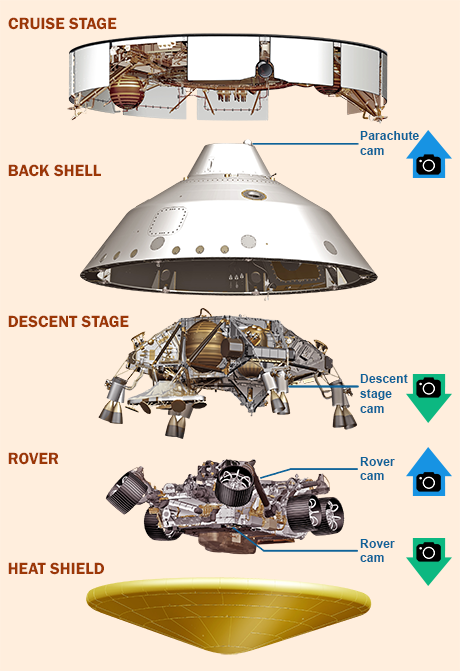
Perseverance spacecraft stages and cameras for descent stages. NASA/JPL, 2020.

Descent cameras: These cameras will document the entry, descent and landing of the rover, providing a first-person view of those dramatic stages from strategic points on the spacecraft. Although not crucial for the mission, recording these rapid events will show the amount of dust produced and how parts of the rover move during a real landing, important learning points for future missions. Viewing that sequence will have a large public engagement value as was shown by the popularity of the computer-generated animation of the landing of the Curiosity rover in 2012, “7 minutes of terror”, which reached over 4 million views on streaming media channels.

  1. Parachute Up-looking camera located at the top of the Back Shell component will document deployment of the parachutes that slow down the fall after entry into the atmosphere.
  2. Descent Stage Down-looking camera located at the bottom of this stage will document the Skycrane manoeuvre that slowly lowers down the rover onto the ground.
  3. Rover Up-looking camera located on top of the rover will document the descent stage release and separation.
  4. Rover Down-looking camera located under the rover will document the Martian surface after the Heat Shield is released during landing. Those Terrain Relative Navigation (TRN) images will help adjust the trajectory of the rover to touch down on a safe location.

Engineering cameras: These cameras will help the rover move around the surface safely and record features to map the area in detail.

  1. Engineering cameras for driving, with high resolution (20 megapixels, 5410x3840px) and a variety of lenses will capture details of the surface to help navigators on Earth decide targets and movements of the robotic arm and its tools.
  2. Hazard avoidance cameras (HazCams) are also used for movement of the rover and the robotic arm. Four cameras in front and two at the rear will provide stereo-images for a 3-D view of Mars.
  3. Navigation cameras (Navcams) can take pictures for analysis of contour and distance with precision to plan movements of the rover in advance for autonomous movement. These two cameras, 42cm apart, are located on top of the Mast of the rover.
  4. Sample collection camera (CacheCam) is a single camera that looks into the sample tubes to record microscopic features of the samples as they are being collected to help keep track of each sample.

Science cameras: Five groups of cameras will assist researchers with the capture of visual evidence for scientific analysis.

  1. Mastcam-Z is a set of two cameras located on the Mast that can be Zoomed to obtain stereo-images at a variety of viewing angles and thus result in 3-D images of close and distant targets (2 magapixels, 1600x1200px).
  2. SuperCam is located on the Mast of the rover and combines an analysis camera and a laser gun that shoots pulses of laser at a precise point that can be smaller than 1 mm and as far as 7m from the rover. The spectrometers in the SuperCam then analyse the plasma released by the laser to determine chemical properties of the rock.
  3. Planetary Instrument for X-ray Lithochemistry (PIXL) is a camera mounted on the turret of the robotic arm that detects X-ray fluorescence to determine the chemistry of particles of less than 1mm in size, it contains a Micro-Context Camera to correlate with natural light images. It searches for chemicals left behind (“fingerprints”) by ancient microbial life.
  4. Scanning Habitable Environments with Raman & Luminescence for Organics & Chemicals (SHERLOCK) is a camera mounted on the turret of the robotic arm. It has a spectrometer, a laser and a camera to take extreme close-ups of material for the study of surface characteristics and signs of past microbial life.
  5. WATSON is a camera located on the turret of the robotic arm. It also collects images of fine textures of rocks and dust. As it is movable, it can be used to examine parts of the rover itself, e.g. monitoring dust accumulation. The rover has a calibration target printed on its front to standardise images and calibrate the instrument.

Perseverance rover cameras. NASA/JPL, 2020. Perseverance rover cameras. NASA/JPL, 2020.
Microphones:

The microphones on the rover will pick up the sound of Mars starting from the descent and landing stages. Some are in the body, for engineering and public engagement, while others are part of the SuperCam and other instruments.

Power:

Perseverance can self-drive for 200 metres per day. It will travel to specific locations to carry-out its mission, to drill samples from the soil and process them. The two-year mission (one Martian year) requires constant and reliable energy and may demand up to 900 watts. This rover, like the previous one and other NASA interplanetary missions, converts heat into electricity using a Multi-Mission Radioisotope Thermoelectric Generator (MMRTG). The heat source is the natural radioactive decay of Plutonium-238, which will produce about 110 watts at the beginning of the mission and decline a little over the years. The generator will recharge two lithium-ion batteries used for daily operations and for large energy demands. The MMRTG is located at the rear of the rover and contains 4.8kg of plutonium, weighing 45kg. The two batteries next to it weigh 26kg with a capacity of 43amp/hr.

Experimental technologies:

Perseverance will carry two experimental artefacts for testing on Mars. This technology demonstration will provide valuable information for the development of future devices tailored to operate in that environment.

  1. MOXIE to test oxygen generation from carbon dioxide (see above).
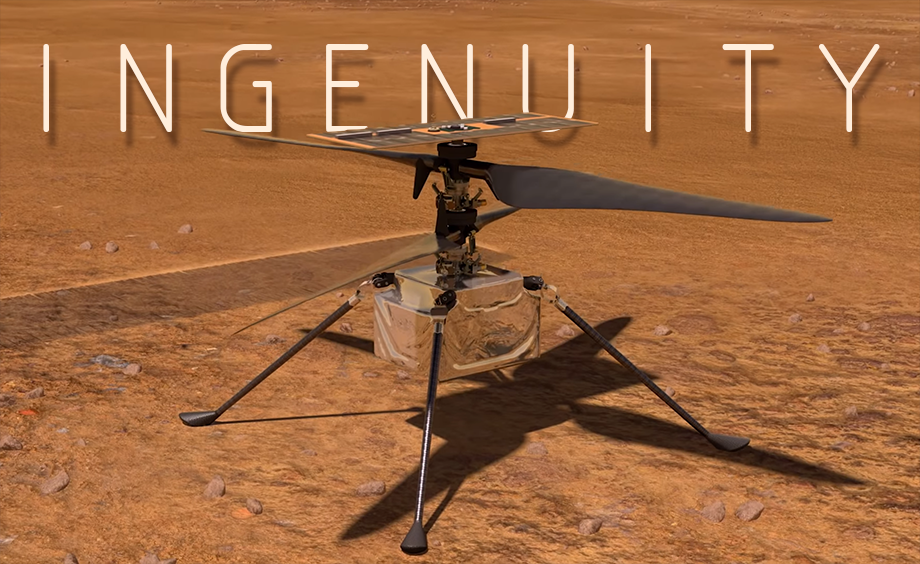
  2. The Ingenuity Mars Helicopter will test powered flight. The helicopter will be bolted to the underside of the rover, protected by a shield to prevent dust contamination. This helicopter was designed by a collaboration of NASA’s Jet Propulsion Laboratory and Lockheed Martin Space. To compensate for the low gravity in Mars (about 1/3 that of Earth), and the extremely light atmosphere (1% as dense as Earth’s), the rotors will have to spin faster (2000-3000 revolutions/min) and the weight of the aircraft had to be reduced to a minimum (1.8kg) while maintaining its capability of autonomous flight. It will also have to keep itself warm to operate in the frigid conditions of Mars (the temperature at night can reach minus 90C). Ingenuity will take short 90-second flights during which it could go as high as 5 metres and as far as 50-70 metres to pre-determined locations, but it will have to travel on its own as remote piloting is out of the question. It will be deployed onto the surface two months into the mission and will have 30 Martian days to complete 5 flights of incremental difficulty.

Ingenuity Mars Helicopter. NASA/JPL, 2020. Ingenuity Mars Helicopter. NASA/JPL, 2020.


Launch of Mars 2020 Perseverance Mission

The Perseverance rover was launched on board the United Launch Alliance's Atlas V rocket from Kennedy Space Centre in Florida on 30 July 2020 (NASA: 2hr 28min video with commentary and details about the mission).

The Perseverance rover was launched on board the United Launch Alliance's Atlas V rocket from Kennedy Space Centre in Florida on 30 July 2020.


REFERENCES

Links open in a new tab or window depending on your browser settings.

» NASA/JPL (2020) Summary of Mars 2020 Perseverance Mission. [Online video]. Available here. (Accessed: 10 Feb 2021).
» NASA (2020) Jazero crater. [Online page]. Available here. (Accessed: 10 Feb 2021).
» Caprarelly G (2015) Probing the Hidden Geology of Isidis Planitia (Mars) with Impact Craters. Geosciences, vol 5, issue 1, 30-44. [Online article]. Available here. (Accessed: 10 Feb 2021).
» NASA/JPL (2020) Perseverance rover: Parts. [Online page]. Available here. (Accessed: 10 Feb 2021).
» NASA/JPL (2020) Science instruments’ details. [Online page]. Available here. (Accessed: 10 Feb 2021).
» NASA/JPL (2020) 23 Cameras. [Online page]. Available here. (Accessed: 10 Feb 2021).
» NASA (2020) Cameras’ details. [Online page]. Available here. (Accessed: 10 Feb 2021).
» NASA (2020) Mastcam-Z details. [Online page]. Available here. (Accessed: 10 Feb 2021).
» NASA (2020) SuperCam details. [Online page]. Available here. (Accessed: 10 Feb 2021).
» NASA (2020) PIXL details. [Online page]. Available here. (Accessed: 10 Feb 2021).
» NASA (2020) SHERLOC details. [Online page]. Available here. (Accessed: 10 Feb 2021).
» NASA/JPL (2020) Experimental technologies: MOXIE + Helicopter. [Online page]. Available here. (Accessed: 10 Feb 2021).
» NASA/JPL (2020) Ingenuity Mars Helicopter. [Online video]. Available here. (Accessed: 10 Feb 2021).
» NASA/JPL (2020) Ingenuity Mars Helicopter tests. [Online video]. Available here. (Accessed: 10 Feb 2021).
» NASA (2012) Curiosity’s 7 minutes of terror. [Online page]. Available here. (Accessed: 10 Feb 2021).
» NASA (2012) 7 minutes of terror. [Online video]. Available here. (Accessed: 10 Feb 2021).
» NASA/JPL (2020) Launch of Perseverance rover on 30 July 2020. [Online video]. Available here. (Accessed: 10 Feb 2021).


Perseverance 3D model


Drag the model to rotate.      
Mouse-wheel to zoom.