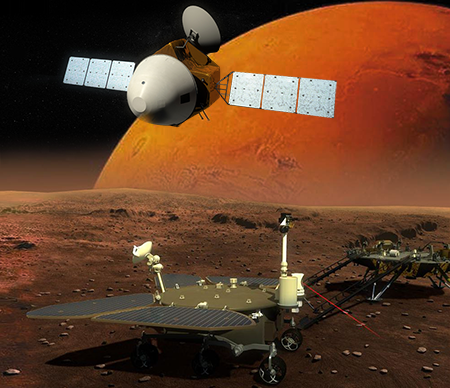
Congratulations Mars 2020 Perseverance Rover Team!
Perseverance successfully landed on Mars on 18 Feb 2021, after travelling 497 km from Earth on a 213-day journey (departed on 30 July 2020).
Entry Descent and Landing (EDL) highlights
The Engineering team at NASA/JPL had a sequence of 38 events lined up for EDL, which started with the separation from the Cruise Stage that took the rover from Earth to Mars.
Shortly before entry into the atmosphere, the spacecraft was at an altitude of 134km from the surface and travelling at 5.3 km/s and carrying 400 kg of fuel.
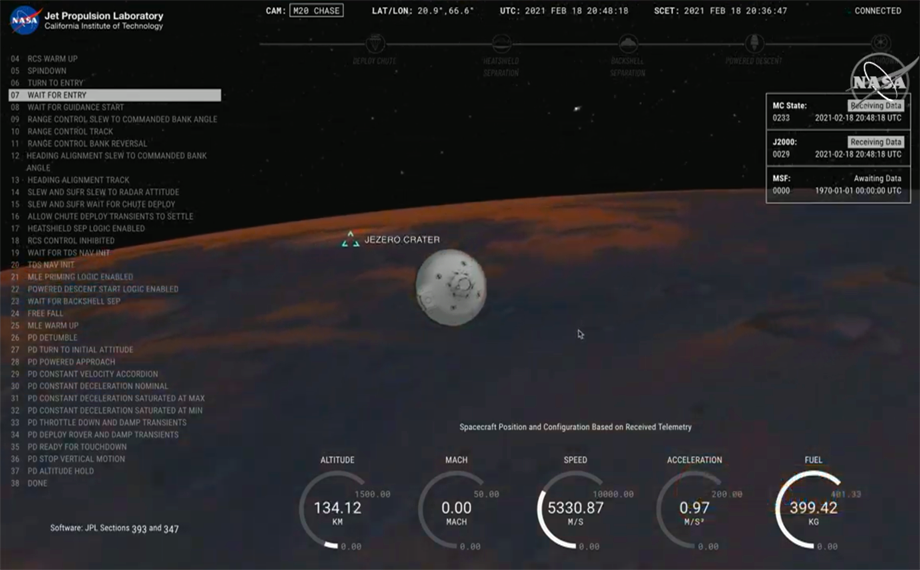 Perseverance spacecraft prepares to enter the Martian atmosphere. NASA/JPL, 2021.
Entering the atmosphere, Perseverance had to go through a rapidly increasing density of air particles. Her heat shield (4.5 m in diameter) protected the rover from friction against those particles, which produced temperatures of over 1,300 C. Once inside the atmosphere, the spacecraft was able to adjust her trajectory of fall using thrusters to aim for the target landing zone; when everything looked promising, at an altitude of 11 km and still falling faster than the speed of sound at Mach 1.23 (286 m/s or 1,030 km/h), she deployed her parachute, the largest ever built for space (at 21.5 m in diameter).
Mach 1 is a flow velocity value that equals the speed of sound, which due to the low Martian surface temperature (average -63 C) is 244 metres per second (m/s) or 878 km/h; this is roughly 100 m slower than the speed of sound on Earth (343 m/s).
 Perseverance spacecraft deploys its supersonic parachute. NASA/JPL, 2021.
The parachute slowed down the spacecraft drastically to a speed of less than 90 m/s, creating a gravitational force of 11 g.
While still on target, Perseverance was spotted by the Mars Recognisance Orbiter and took a picture as she approached the Jezero crater.
 Perseverance on a parachute approaching Jezero crater. Picture from the Mars Recognisance Orbiter, NASA/JPL, 2021.
Hanging from the parachute, the first images taken by the up-looking camera of the Back Shell show the canopy (made of polyester and nylon) fully inflated against the clear sky of a sunny Martian day.
The top vent is a hole in the centre of the parachute that controls for rocking movements. The 48 suspension lines converge in the swivel that links them to three tethers or Triple Bridle made of Kevlar, an extremely resistant material used for bullet-proof vests. The triple bridal that connects the parachute to the back shell was designed to hold an inflation load of 8.1-8.6 tonnes (80,100 - 84,600 Newtons [N]), which is close to the expected force created by the falling weight of the spacecraft (about 1 tonne) and the speed of fall.
Note: A Newton is the unit of force required to accelerate a mass of one kilogram one metre per second.
 Supersonic parachute slowing down the fall of Perseverance. Picture taken by the up-looking Parachute Cam on top of the Back Shell. NASA/JPL, 2021.
Once the parachute had slowed down the fall sufficiently, the lander separated from the Back Shell by sliding down a metal tape to take position at the end of a 20-metre long bridle made of Zylon (a material similar to Kevlar braided in a webbing pattern like those used for sailing), this provided enough distance for the Descent Stage solid rocket motors exhaust stream. When the parachute was no longer needed, the Descent Stage thrusters fired and the Back Shell was released, switching to powered controlled descent.
Shortly after, the Rover extended her wheels and was slowly lowered by a crane operation onto the ground. The Descent Stage camera took images of dust being blown away by the thrusters as Perseverance approached the Martian surface.

Perseverance rover lowered down on cables from the Descent Stage. NASA/JPL, 2021.
A close-up of the rover shows that all parts were still in place and ready for touch-down.

Close up of Perseverance from the Descent Stage look-down camera. NASA/JPL, 2021.
Landing site
Planning the landing site for the rover was limited by the moderate resolution of the reference images taken by the spacecraft orbiting around Mars. The final selection of the landing spot had to be done by the rover’s software based on the analysis of photographic and radar data obtained during the rapid descent.

The next images show the location of the Jezero crater on the north-east edge of the Isidis Basin or Planitia. The colours illustrate altitude levels relative to the green areas, which represent zero altitude. Blue areas are lower, while yellow and red zones are raised.
The Jezero crater has a delta (a raised area coloured in purple) near its northern rim, which corresponds to a canyon that once was a river.
Read more at Persevere to Succeed.
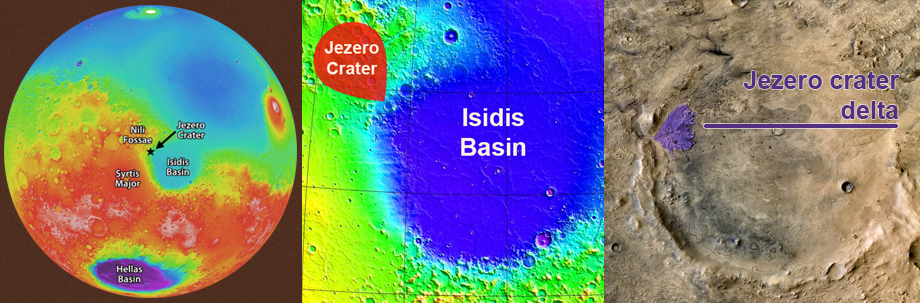 Mars and the location of the Isidis Basin, the Jezero crater and its delta. NASA/JPL, 2020.
In an image taken by the Mars Reconnaissance Orbiter, the large elevated delta inside Jezero crater is visible at the top. A flat, depression separates the edge of the delta from the Canyon De Chelly (named after the national monument in Arizona, USA and pronounced “de-shay”, a word derived from the Navajo [Tséyi], meaning “inside the rock” or “canyon”, and borrowed to the Spanish “Chelly”, then adapted to English with a French-like pronunciation), near the final landing spot, approximately 2 km southeast.
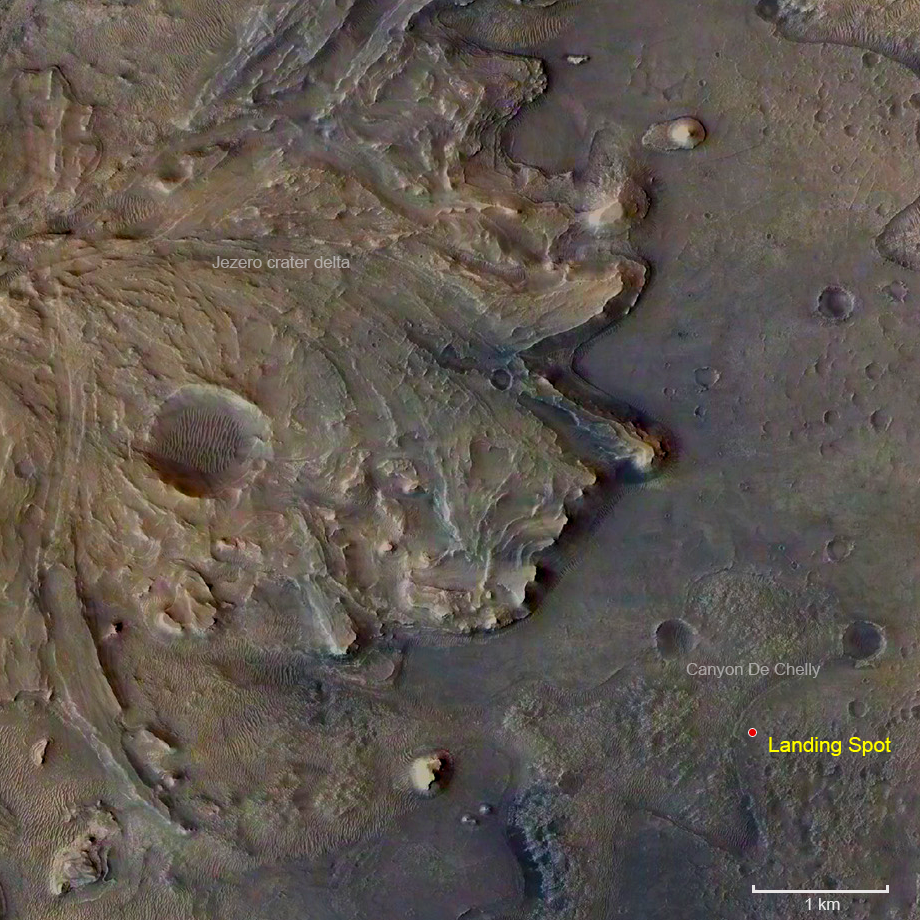 Perseverance’s landing spot inside the Jezero crater, southeast of the delta. Mars Reconnaissance Orbiter. NASA/JPL, 2021.
Satellite pictures of the planned landing area were previously analysed and a mapped by geologic units, which refer to the smoothness or roughness of the surface. The landing spot is within an ideal smooth unit, surrounded by a fractured unit and a fractured rough unit.
 Jezero crater’s geologic units showing the landing spot in a smooth unit, NASA/JPL, 2021.
A photograph taken by the Rover down-looking camera shows the heat shield separating. In the background is the bottom of the Jezero crater as seen by the rover with the final landing spot marked for reference.
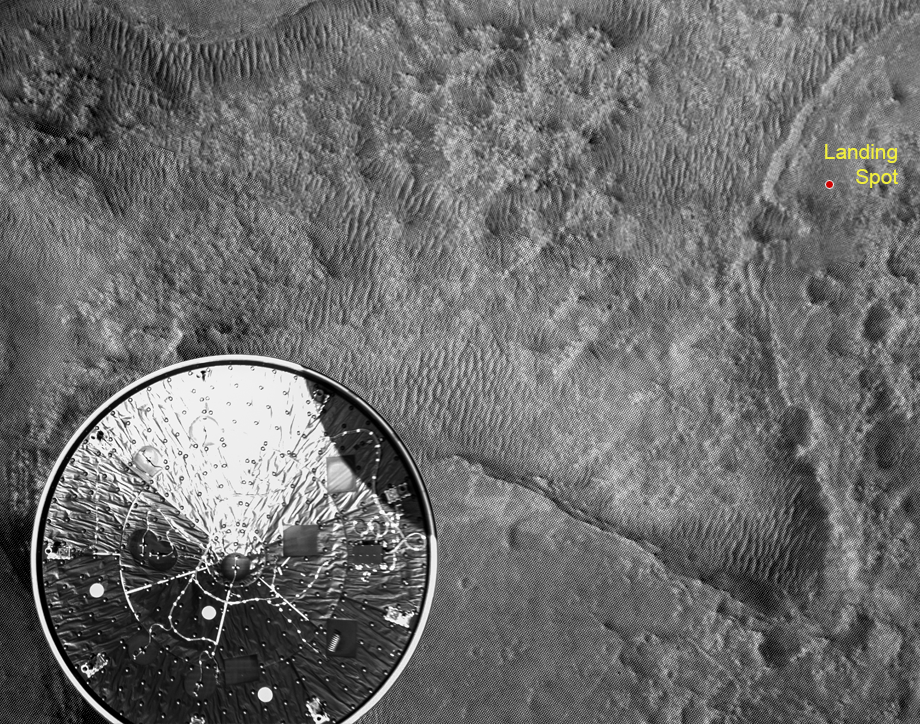 Heat Shield separation and Jezero crater with the targeted landing spot. Perseverance rover, NASA/JPL, 18 Feb 2021.
Closer to the surface, the rover took more pictures used to aim at the safest landing spot, flat and smooth, with the least amount of irregularities that may obstruct the rover’s functions and movement but also close to interesting features that she will explore during the mission.
 Jezero crater, closer view and spotted landing site. Perseverance rover, NASA/JPL, 18 Feb 2021.
Heat Shield in free-fall over Jezero crater’s delta.
 Heat Shield in free-fall over Jezero crater, Mars. NASA/JPL, 18 Feb 2021.
Touchdown!
As soon as Perseverance touched the ground, she cut off the cables that connected her to the Descent Stage, which flew away to a distant and safe place crashing on the terrain when it run out of fuel.
Photographs taken by the rover’s up-looking camera show the Descent Stage during the Crane operation and as it flies away in a cloud of dust produced by its thrusters as it gently place the rover on the ground.
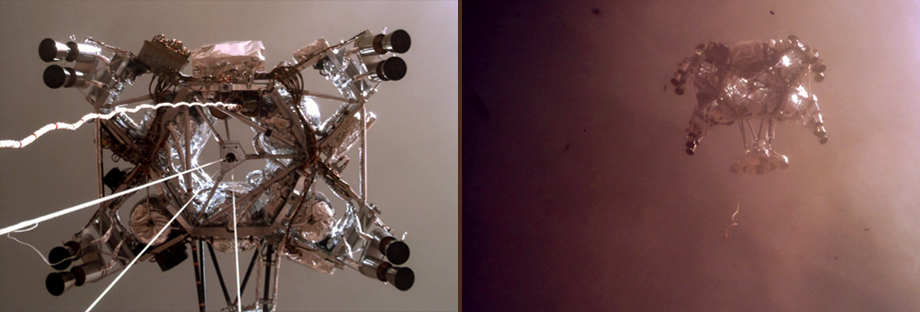 Descent Stage. Photograph taken by the Rover’s up-looking camera as it was being craned down and as it flew away. NASA/JPL, 18 Feb 2021.
Touchdown celebrations
The teams of specialist at the Mars 2020 Perseverance control rooms at NASA/JPL were nervously monitoring every moment of the agonising seven minutes of Entry, Descent and Landing (EDL). EDL may be calculated, planned and computer-simulated but cannot be tested on Earth. There is only one chance for it to either be successful or fail and that happens on the surface of Mars.
The tension of the countdown to touchdown peaked when it was announced “Touchdown Confirmed!” The control room exploded into celebratory growls, cheering, clapping and sighs of relief for a magnificent achievement. All went according to plan.
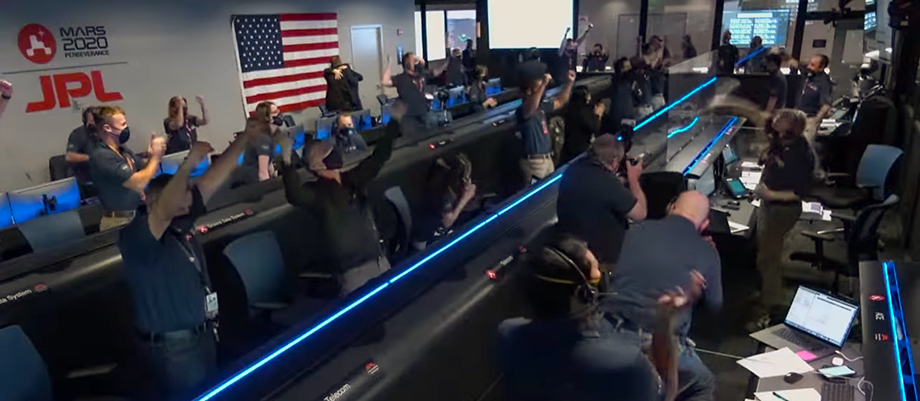 Celebrations at the NASA/JPL control room after the announcement of touchdown. NASA/JPL, 18 Feb 2021.
The event was broadcast live on NASA’s YouTube Channel and viewed by millions around the world.
Raquel Villanueva, the host of the show, introduced the project and presented interviews with representatives from the administration, management, engineering and other teams; this included Steve Jurczyk, Acting NASA Administrator. Co-host Marina Jurica, presented interviews with the scientific team and special guest from the public.
 Sample of participants in the live broadcast of Perseverance landing via YouTube on 18 February 2021.NASA, YouTube, 18 Feb 2021.
First images from Mars
Because Mars is 204 million kilometres away, it takes 11 minutes for data to arrive to Earth, despite travelling at the speed of light. Everything we know about the landing has happened at least 11 minutes ago! The round-trip for signals sent and returning from the rover take at a minimum 22 minutes, a lagging phenomenon known as “2-way light-time”.
The first tangible proof of success were the first images of Mars taken by Perseverance, using the engineering navigation cameras (NavCams), which point to the ground in front of the wheels.
 First pictures sent by Perseverance from Mars arrived on 18 February 2021. NASA/JPL, 18 Feb 2021.
Vast amounts of dust were stirred up and blown away by the thrusters propelling the Descent Stage as it hovered at an altitude of 21 metres to drop down the rover; the first images were blurry and distorted due to the transparent shield protecting the Navcams from the dust. Once the dust had settled, the lens shields came off and better-quality pictures were taken.
 Cleaner pictures of the landing zone on Mars, taken by the right and left Navcams on board the rover. NASA/JPL, 18 Feb 2021.
Mars 2020 Perseverance Rover mission begins
Perseverance landed on the surface of Mars with her back facing the delta, which was north-west to her; her front was facing southeast, pointing at the Isidis Basin or Planitia. The site was almost flat, with an inclination of one degree. Part of the natural dust covering the rocks was dispersed by the blast of the Descent Stage’s thrusters, uncovering features on their surface.
The images taken by the Navcams show rocks with small holes all over their surface which on Earth may suggest a volcanic origin, like pumice rock with holes (vesicles) on its surface. Sedimentary rock might also develop holes when parts of their components dissolve in water, leaving holes on the surface. The material on the surface is likely to be a few billion years younger than the Jezero Crater, which is thought to have formed around 3.9 billion years ago.
The small holes on the surface of rocks resemble those found on rocks brought from our Moon, which are thought to be the result from air bubbles trapped in lava.
 A rock sample brought from our Moon in 1960s shows a surface similar to those seen on Mars. NASA/JPL, 18 Feb 2021.
At a high-resolution, the holes on the rocks seem to have sharp edges with some evidence of friction, or erosion as it occurs in fluvial deposits (exposed to flowing liquid and sand).
 A closer look at surface rocks on Mars next to the rover’s wheel. Picture by SuperCam, NASA/JPL, 22 Feb 2021.
Although all activities carried-out on the surface of Mars are pre-sequenced and scripted, Perseverance can adjust to local conditions to fulfil those commands. Confident on this ability, operators at the control room at NASA/JPL send commands to the rover once a day.
One of the first commands sent to the rover was to verify her status of health, checking her instruments and the function of the main and the backup computers. This process took four days and was essential before the start of the surface mission.
Satisfied that the rover’s software was in good form, the mast was raised, and the high-resolution cameras began taking pictures. The first images were of the rover’s body and parts to verify that everything was in place and looking healthy.
 Details of the surface of the rover taken by SuperCam. NASA/JPL, 22 Feb 2021.
SuperCam was used at its best to take pictures of the rover’s surroundings. Those images were joined together to create a 360-degree high-resolution panorama of the Jezero crater.
 360-degree panorama of Jezero crater, taken by SuperCam. NASA/JPL, 25 Feb 2021.
The hilltops at the distance correspond to the raised edges of the delta and the Jezero crater (green area below).
 A section of the 360-degree panorama of Jezero crater showing the delta. Photo by SuperCam. NASA/JPL, 25 Feb 2021.
A closer look at the rock formation in front of the hills of the Jezero delta at the top of the previous picture gives us an example of the imaging capabilities of the SuperCam (yellow area below).
 Closeup of rock formation rising in front of the Jezero delta. Photo by SuperCam. NASA/JPL, 25 Feb 2021.
At full resolution, the details and depth separation between the boulders, the rock formation and the mountains in the background are more evident (orange area below).
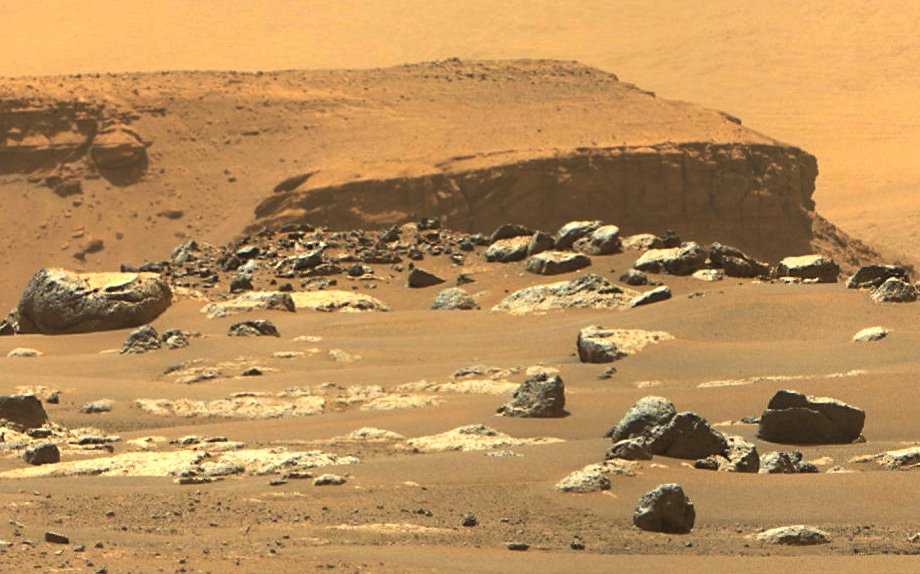 Full-resolution extreme-closeup of boulders in front of the rock formation. Photo by SuperCam. NASA/JPL, 25 Feb 2021.
The image below shows the approximate angles covered by the pictures above: The portion of the panorama in green; a closer look at the rock formation in yellow and a full-resolution closeup in orange.
Forming the horizon in the pictures above, the north-east edge of the Jezero crater appears as a large mountain range and a slightly taller mountain separated by a valley, which corresponds to the canyon that once was the inlet river and appears on the left side of the picture below.
 Jezero crater’s delta and inlet valley. Approximate angles of coverage of the pictures above from Perseverance’s landing spot. Mars Reconnaissance Orbiter, NASA/JPL, 2020.
On 5th March 2021, the landing site was given a name: “Octavia E. Buttler Landing” after an award-winning sci-fi writer from California, USA.
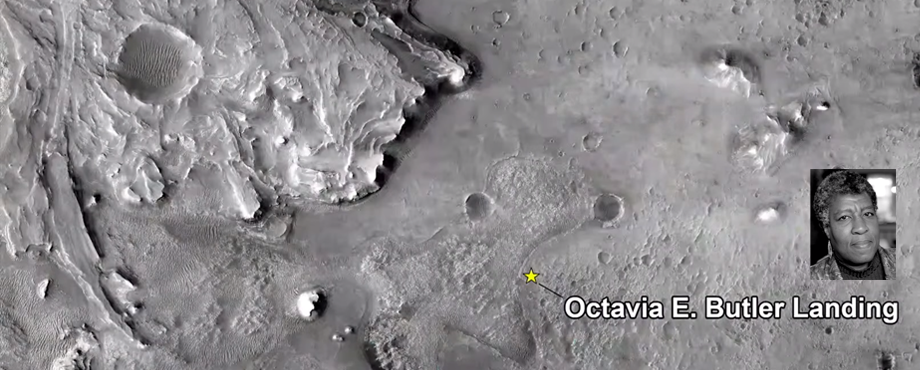 Perseverance landing site named after sci-fi writer Octavia E. Buttler. NASA/JPL, 05 Mar 2021.
All systems, Go!
In the first three days after landing the Surface Mission Team executed more than 5,000 commands to check the health status of the rover. All systems were working well, including the Flight Software Update, which is essential to release all the available capabilities of the rover to perform her surface mission. The software is small at 16MB but able to run 140 tasks simultaneously and has been developed in many years and tested on previous rovers.
 Top view of Perseverance rover, sol 13. Photo by SuperCam. NASA/JPL, 25 Feb 2021.
On 4th March 2021, the rover took her first drive. Her six wheels have independent motors for traction, steering is done with the front and rear wheels, while the centre wheels are for support. The suspension keeps the rover high and allows the wheels to drive over obstacles as high as the diameter of a wheel. Although the standard speed is about 150m/h (0.1 km/h), the rover can drive faster, up to 0.8 km/h.
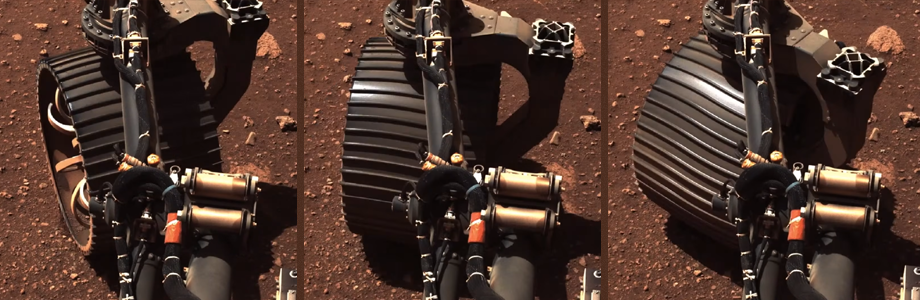 Tests of rotation of Perseverance’s front wheels. NASA/JPL, 04 Mar 2021.
 Wheel tracks showing the first run of Perseverance on Martian soil. NASA/JPL, 04 Mar 2021.
Videos from Mars
In those few days, Perseverance sent over 30 Gigabytes of information and over 23,000 images, this included the first ever videos of Descent and Landing, thanks to cameras on top of the Back Shell, below the Descent Stage and above and below the Rover. The cameras took video at 75 frames per second, which allows viewing in smooth slow motion to appreciate and study every detail from different points of view.
REFERENCES
(Links open in a new tab or window depending on your browser’s settings.)
1. » NASA (2021) What’s Next for Perseverance Mars Rover? Sol 1 Press Conference. 21 Feb. 2021 [Online video]. Available here. (Accessed: 19 Feb 2021).
2. » Wikipedia (2021) Mach number. [Online page]. Available here. (Accessed: 19 Feb 2021).
3. » Clark S (2021) What to expect during Perseverance’s landing on Mars. Spaceflight now, 18 February 2021. [Online page]. Available here. (Accessed: 19 Feb 2021).
4. » NASA (2021) Mars Perseverance RAW images. [Online page]. Available here. (Accessed: 23 Feb 2021).
5. » NASA-JPL (2020) Spacecraft: Parachute. [Online page]. Available here. (Accessed: 24 Feb 2021).
6. » Woodford C (2021) Parachutes. Explainthatstuff.com. [Online page]. Available here. (Accessed: 24 Feb 2021).
7. » NASA-JPL (2021) Perseverance's Landing Spot in Jezero Crater. [Online page]. Available here. (Accessed: 25 Feb 2021).
8. » Wikipedia (2021) Canyon de Chelly National Monument. [Online page]. Available here. (Accessed: 26 Feb 2021).
9. » NASA-JPL (2021) Landing broadcast: Perseverance Rover Lands on Mars. Hosted by Raquel Villanueva. [Online video]. Available here. (Accessed: 26 Feb 2021).
10. » NASA (2020) Virginia Middle School Student Earns Honor of Naming NASA's Next Mars Rover. [Online page]. Available here. (Accessed: 27 Feb 2021).
11. » NASA-JPL (2021) NASA’s Perseverance Rover Gives High-Definition Panoramic View of Landing Site. [Online page]. Available here. (Accessed: 26 Feb 2021).
12. » NASA-JPL (2021) NASA's Perseverance Rover Sends New Video and Images of the Red Planet – 22 Feb 2021. [Online video]. Available here. (Accessed: 04 Mar 2021).