 Title: Ingenuity Mars Helicopter, April 2021: The first powered flight in another planet pays a tribute to the Wright brothers’ first powered flight on Earth in Dec. 1903. NASA/JPL, 2021.
First powered flight on Mars
The “Mars 2020 Perseverance Rover” mission that landed on Mars on 18 February 2021 brought onboard an experimental helicopter named “Ingenuity”. The aircraft was secured underneath the body of the rover protected from heat, impact and dust by a plate and the Debris Shield. On 19 April 2025, the aircraft successfully performed the first powered flight on another planet.
Go to
Updates
End of mission, January 2024.Last aerial photo, 05 February 2023.
Back Shell found, 20 April 2022.
Background
Ingenuity Helicopter.Ingenuity in Stereovision.
First flight on Mars.
Flight videos.
Mission accomplished.
The ingenious team.
UPDATES
End of Ingenuity Mars Helicopter’s mission – January 2024
After 72 flights in 3 years on Mars, Ingenuity Mars Helicopter is unable to fly. It performed well beyond its experimental design that aimed at completing 5 flights in 30 days.
Although the aircraft remains upright and in communication with ground controllers, the last images sent to Earth on 18 January 2025 show damage to the rotor blades. The damage was confirmed by satellite images that show that the aircraft is on an inclined terrain and has lost a portion of its blades.
NASA’s investigation of the accident concluded: "Lack of surface texture gave the navigation system too little information to work with”. Landing on an inclined terrain caused the blades to hit the ground and fragment, permanently disabling its flight capability.
 Top: Satellite image of Ingenuity and a fragment of its blade (encircled). Bottom: Photographs of the shadow cast by the broken blade (NASA, 2024).
“The historic journey of Ingenuity, the first aircraft on another planet, has come to end,” said NASA Administrator Bill Nelson. “That remarkable helicopter flew higher and farther than we ever imagined and helped NASA do what we do best – make the impossible, possible. Through missions like Ingenuity, NASA is paving the way for future flight in our solar system and smarter, safer human exploration to Mars and beyond” (NASA, 2024).
“It’s humbling Ingenuity not only carries onboard a swatch from the original Wright Flyer, but also this helicopter followed in its footsteps and proved flight is possible on another world,” said Ingenuity’s project manager, Teddy Tzanetos of NASA JPL (NASA, 2024).
In the following video, NASA administrator Bill Nelson announces the end of Ingenuity Helicopter’s mission (3min).
--O--
Ingenuity’s last aerial picture – 05 February 2023
Perseverance’s Ingenuity Helicopter flew for the last time on 05 February 2023, this was her 42nd flight after 697 Martian days on the planet (Sol 697).
The last aerial image taken at 22 Degrees below the horizon shows dust dunes on a rocky irregular terrain and rounded hills on the background.
 Rocky terrain and sand dunes under the horizon seen on Ingenuity Mars Helicopter’s last aerial photograph.
Flight 42, sol 697 (NASA, 05 February 2023).
--O--
Back Shell found - 20 April 2022
During flight 26, Sol 414 (Martian days since landing), Earth date: 20 April 2022, Ingenuity flew over the debris of Perseverance’s Back Shell. This section was fitted between the rover and the parachutes and was released when the Descent Stage took over for controlled flight. The Back Shell continued its descent held by the parachutes until it touched down on Martian ground.
Images captured by Ingenuity show that despite the parachutes the Bach Shell crashed onto the ground with sufficient force to break it into large and small particles.
 Perseverance Back Shell remains on Mars. Image by Ingenuity helicopter. Flight 26 on Sol 414, 20 April 2022.
Note damage on impact, the parachute (top-right) and shadow of Ingenuity (bottom-left) (NASA, 2022).
END of UPDATES
BACKGROUND
Ingenuity Helicopter
One month into the mission the protection plate and the Debris Shield were released, and the rover travelled 15-20m away to the helicopter drop-off location, where Ingenuity touched-down on Mars. The deployment of the helicopter was a complex procedure and it took two weeks of meticulous testing and recording of every step to ensure a safe operation and to inform the engineering team on Earth about the status of the aircraft.
On Martian day (sol) 31, the Debris Shield was dropped under the rover. On sol 37, Ingenuity was seen secured under the fuselage as the careful process of her release began.
 Debris shield deployed on the ground revealing Ingenuity tucked under the rover. Initiating deployment of Ingenuity’s body. NASA/JPL, Mars, sol 31 and 37, 2021.
The deployment of the helicopter started with the release of two legs, followed by gradual inclination of the body until it reached a vertical position. The legs almost touched the ground on sol 38.
 Ingenuity’s 2 legs tip-toeing close to the ground under the rover. NASA/JPL, Mars, sol 38, 2021.
On sol 39, the four legs of Ingenuity were close to the ground. She passed all tests of health and functionality and was almost ready to be released.
 Ingenuity’s 4 legs close to the ground under the rover. NASA/JPL, Mars, sol 39, 2021.
Ingenuity touches down on Mars!
On sol 40, Ingenuity Mars Helicopter was released from the underside of Perseverance and finally touched down on Mars, which marked the beginning of her individual mission.
 Ingenuity Helicopter on Mars, the beginning of a historic mission. NASA/JPL, Mars, sol 46, 2021.
 Ingenuity on Martian ground as the rover drives away. NASA/JPL, Mars, sol 43, 2021.
Flying on Mars is a challenge because its atmosphere has only 1% of the density of Earth’s; this means there are less particles of air to support lift. Despite its light weight (1.8kg), Ingenuity needed extremely light blades (35g) made of foam wrapped in carbon fibre, with more length (60cm-blade and rotor span of 1.2m) and a tailored contour optimised for lift. The helicopter also required a double set of blades rotating in opposite directions at 50 to 2,400 revolutions per minute (rpm); much more than any aircraft would need on Earth.
Due to the complexity of flight control, the computing ability of the helicopter is comparable to that of a smart phone from 2017, which has more than 100 times the power and speed of any device sent on previous missions by NASA. As a reference, the computing power on Perseverance is like that on the previous rover, Curiosity, which landed on Mars in 2012. The hardware was not substantially upgraded because it has proven to be reliable and appropriate for her mission.
Ingenuity’s flight control is based on “fprime”, an open source flight software and system framework freely available at Github and NASA.
 Mars Ingenuity helicopter on the ground or helipad, separated from the rover. NASA/JPL, sol 44, 2021.
 Mars Ingenuity helicopter on the helipad. Perseverance rover wheel in the foreground. NASA/JPL, sol 44, 2021.
According to plan, Ingenuity needed a safe Flight Zone that extended 15-90m from the point where she was dropped, called the Helipad. This 3x3m area needed to be flat or with less than 4-degree inclination, with few rocks, less than 5cm tall, and close to areas of visual interest.
Members of the helicopter team used the images sent by Perseverance during descent and landing to find an area for this flight zone. After careful considerations, the zone was selected, and located just north of Perseverance’s landing site covering an estimated Airfield area of 10x10m.
 Outline of Ingenuity helicopter’s helipad zone, just north of the landing site of Perseverance. NASA/JPL, 2021.
As evidenced during landing, there is a fine layer of dust covering the surface of Mars; it was likely that Ingenuity’s attempts to fly would displace large amounts of debris. With this in mind, the rover drove around 60m away from the helipad to a safe, raised area (1m higher) called the “Twitcher zone”, a bird-watcher’s term for a viewpoint with good visibility, which in this case also ensured a strong radio signal for wireless communications. From that distance the rover was able to continue her mission and take pictures of ingenuity while she recharged her batteries and attempted flight.
The NASA/JPL team named this point the “Van Zyl overlook” in honour of Dr Jacob van Zyl, former Director for Solar System Exploration who passed away on 26 Aug. 2020, shortly after the launch of the Mars 2020 Perseverance mission (30th July). He was an innovator and leader in many successful operations, including the lander InSight, that touched down on Mars on 26 Nov 2018 and the current Mars Helicopter team.
 Van Zyl Overlook is the location from where Perseverance will watch Ingenuity perform its test flights. It was named in honour of Dr Jacob van Zyl. NASA/JPL, 2021.
The Mars Helicopter mission has a time window of 31 sols during which the team will attempt at least 5 autonomous flights, hopefully with successful landings.
The most crucial part of the mission is its first flight, which will mark a historical moment for humanity as the first powered flight in another planet. The plan was that during this event, Ingenuity will attempt to climb at a speed of 1m per second to an altitude of 3m, hover for 20 seconds, turn the body and descend at the same speed, making a total flight time of around 40sec.

During flight, Ingenuity takes 30 images per second, analyses those images to track the features on the ground and determines how it is moving. This information is combined with other navigation tools (inertia guidance sensor and laser altimeter), to make small adjustments to its parts 500 times per second and follow her route. She can adjust its trajectory autonomously to recover from disturbances like wind and continue with her mission.
News of the flight will arrive to NASA a few hours after the event in the form of raw data, which must be analysed to find indicators of the activity. The flight engineer or pilot will look for evidence of flight and a confirmation will be reached when that information matches readings from the altimeter. If the aircraft lands following the precise instructions sent from Earth a few hours prior, it will be regarded as a “mission success”.
In addition to the black and white navigation camera that points to the ground, Ingenuity has a 13-megapixel colour camera that will take pictures from her side. The picture on the right shows the first test of the colour camera when the helicopter was under the rover.
Ingenuity’s blades were tested for rotation on sol 47 at low speed of 50 rpm, and on sol 49 (09 April 2021) at flight speed of 2,400 rpm before attempting to fly.
 Ingenuity helicopter testing blade rotation on Mars. NASA/JPL, sol 47, 2021.
At close inspection, the solar panel shows some dust over part of its surface, but most of the cells look relatively clean and were enough to recharge the batteries.
 Ingenuity helicopter on Mars: Close-up of rotor mechanism. NASA/JPL, sol 47, 2021.
Test your stereovision
A stereo view of Ingenuity Mars Helicopter from the distance. Place this image in front of you and try to “cross your eyes” slowly. When you reach the “sweet spot” you will see the helicopter in depth, standing against the rocks on the background, just as the rover’s Mastcam-Z saw her on Mars on sol 45, when the helicopter was deployed.
 Stereo photo by Mastcam-Z: Ingenuity helicopter on Mars soil next to a rover track, shortly after its release. Z. NASA/JPL, sol 45, 2021.
Perseverance rover moved away to a safe zone and took this picture of Ingenuity on sol 48.
 Stereo photo by Mastcam-Z: Ingenuity helicopter on Mars. NASA/JPL, sol 49, 2021.
Blade spinning test at a distance in Stereo, on sol 49.
 Ingenuity helicopter on Mars: Paired Stereo-Photograph taken by the rover’s Mastcam-Z. NASA/JPL, sol 49, 2021.
Preparing to fly
Ingenuity is powered by onboard lithium-ion batteries that recharge during the day using a solar panel installed above the rotors. The batteries provide power to keep the helicopter warm during the extremely cold nights (-90C), maintain wireless communication with her base station on the rover and sustain flight for up to 90-seconds per day.
At peak powered flight, the helicopter uses more than 350Watts of power, which limits her coverage and number of flights because she must return to its safe, flat helipad. Ingenuity has no provision to land in any other type of terrain.
The laser altimeter also limits her capabilities because it is adequate up to an altitude of10m, and depends on good visibility, which might be compromised by dust. The navigation cameras also need clear detail on the ground that naturally decreases at higher altitudes.
On 09 April 2021 Ingenuity successfully tested spinning her blades at full speed (2,400 rpm) in preparation for her first flight.
 Ingenuity helicopter testing blade spinning. Seen from the Van Zyl overlook, about 60m away. NASA/JPL, sol 48, 2021.
The picture below shows Ingenuity on the helipad surrounded by familiar features like the large rock formation or delta remnant called Kodiak in the valley behind her, which is likely to have been an island when Jezero crater was a lake. Further afar are the hills of the Jezero delta.
 Ingenuity helicopter seen from the Van Zyl overlook. Behind her is the large rock formation “Kodiak”, a delta remnant located in the next valley. NASA/JPL, sol 49, 2021.
To ensure a robust flight, the team selected a flight time shortly after noon, when weather conditions were favourable. The META team that monitors the weather from the rover were uncertain about the predominant winds at that time, but the system was designed to adapt to a range of wind speeds automatically.
 Stereo photo: Ingenuity helicopter as seen from the Van Zyl overlook. The helipad sits in a shallow valley. NASA/JPL, sol 58, 19 April 2021.
First powered flight on Mars
19 April 2021

The initial plan of flying the helicopter for the first time on Sunday 11 April had to be revised because a high-speed spin test of the rotors reported an error: it was unable to transition from ‘Pre-Flight’ to ‘Flight’ mode. The engineering team studied the data and had to uplink a new version of the flight software to the helicopter and test it before the first flight attempt.
The historic event was delayed beyond the 154th birth anniversary of the eldest of the Wright brothers, Wilbur, who was born on 16th April 1867. The Wright brothers built and flew the first powered aircraft in 1903 (see below).
On Monday 19th April 2021, Ingenuity Mars Helicopter flew for the first time on Mars, the first powered flight on another planet.
Actual video of Ingenuity Mars Helicopter taking flight for the first time on Mars, filmed by Perseverance rover parked on the Van Zyl Outlook on 19 April 2021, using the Mastcam-Z video camera.
Ingenuity’s first flights in Stereovision
This pair of stereo-images taken by the Navigation cameras onboard Perseverance on sol 61 (22 April 2021) show Ingenuity hovering 5 metres above the Wright Brothers Field. This second successful flight provided further evidence that self-controlled flight of a robotic aircraft on Mars was possible.
 Stereo photo: Ingenuity Mars Helicopter hovering 5m above the Wright Brothers Field, Jezero crater, Mars. NASA/JPL, sol 61, 22 April 2021.
On sol 64 (25 April 2021) Ingenuity flew further away before returning to the helipad.
 Stereo photo: Ingenuity tested for translation flight. Jezero crater, Mars. NASA/JPL, sol 64, 25 April 2021.
On sol 64 (25 April 2021) Ingenuity flew further away before returning to the helipad.
Stereo photo: Ingenuity tested for translation flight. Jezero crater, Mars. NASA/JPL, sol 64, 25 April 2021.
During her second flight on 22 April 2021, Ingenuity Mars Helicopter took a colour picture of the tracks left by the rover from an altitude of 5.2m.
 Ingenuity’s photo of Perseverance’s tracks, taken from an altitude of 5.2m Jezero crater, Mars. NASA/JPL, sol 61, 22 April 2021.
On 28 April 2021, Ingenuity took a picture of Perseverance rover from an altitude of over 5m. The picture shows the rover and the rover’s landing site.
 Ingenuity’s photo of Perseverance rover and her landing site from an altitude of over 5m. Jezero crater, Mars. NASA/JPL, 28 April 2021.
Transition from technological to operational
The Ingenuity technological demonstration was a resounding success. As the Perseverance rover team was also ahead of schedule, the helicopter could begin further testing, moving from a technological demonstration to an operational demonstration, with the inclusion of:
- Aerial observation of science targets not accessible by rovers
- Scouting for potential science observation areas accessible by rovers and new airfields to land
- Stereo imaging for digital elevation maps
NASA extended the experimental window from 1 to 5 months, until the end of August but with less frequent flights as Perseverance needed to continue with her science mission, which was paused to help with the helicopter demo flights.
The fourth flight took Ingenuity 133m south of the helipad (Wright Brothers Field) before returning, completing an extended flight of 2 minutes (30 seconds more than its designed capability). The helicopter took 60 black and white and 5 colour images with the goal of surveying the land for potential sites for landing. After landing, the black and white engineering images were used to make 3D elevation maps and define new potential airfields for landing.
During flight, the series of images captured by the navigation camera on Ingenuity were autonomously analysed by her software to determine her position and make adjustments 500 times a second. The green points in the image below correspond to features on the ground recognised as repeated in subsequent images, if they failed to repeat, they were rejected and not used for tracking (red dots).
 Animation: Features on the ground used as reference points to calculate position from a series of images taken by Ingenuity.NASA/JPL, 30 April 2021.
Following changes of those green reference points on sequential images, taken 30 times per second, Ingenuity was able to calculate her position, velocity and altitude. Those values were used to match flight instructions sent by a pilot on Earth a few hours earlier. Unexpected changes in position, like those created by wind could be recognised and compensated for to return to the planned trajectory. Measurements were extremely accurate, with errors within 25cm for position, 1cm for altitude and 1.5 degrees for heading or direction of travel. Not bad for a robotic vehicle operating on another planet
On 01 May 2021, sol 69 on Mars, Ingenuity went further from her initial helipad, embarking on an operational scouting flight.
 Stereo photo: Ingenuity in flight with the Jezero delta in the background. NASA/JPL, sol 69, 01 May 2021.
On the fifth flight, Ingenuity landed on a new location, in preparation for more risky experimentation on a new airfield. Evidence of communications with the rover during testing showed a strong signal, which is thought to exceed initial estimates of 100m. It is likely that Ingenuity will be able to fly up to 1km away and remain in contact with the rover.
The biggest factor that prevents longer flights is the temperature of the motor which raises at a rate of 1C per second during flight and may lead to overheating. The rechargeable battery has shown to be less of a constraint, it has provided enough power to keep the helicopter warm at night and support flights when needed.
More flight videos
Video of Ingenuity’s third flight on Sol 64. This time the helicopter demonstrated side movement flying 50m downrange and returning to its base.
Video and sound of Ingenuity’s fourth flight from 30 April 2021. The initial humming sound corresponds to wind hitting the SuperCam microphone. Ingenuity’s blades rotating at high speed (2,537 rpm) produce a low-pitched burring sound like an electrical bur (frequency: 84Hz) that changes as it flies away and returns into frame. The rover was parked 80m away of the helipad, Ingenuity travelled 133m and back to land again on the Wright Brothers Field.
Steve Jurczyk, NASA Acting Administrator congratulated the Ingenuity Helicopter team, the Perseverance team and all the research centres involved in the Mars mission because this was an “all hands on deck” effort, particularly when a delay called for a coordinated action to solve a problem, which has always been the hallmark of NASA and JPL.
The Helicopter team celebrated the confirmation by altimeter data that Ingenuity had a successful first flight.
 The Ingenuity Mars Helicopter Team celebrates Altimetry confirmation of Ingenuity’s first flight on Mars. NASA/JPL, sol 58, 19 April 2021.
Using the flight data from Ingenuity, the engineering team was able to reconstruct the first flight as a 3D animation, which allows a better analysis of the event and experiment with different viewing points as they can animate the virtual camera to rotate around the helicopter.
 Computer reconstruction of Ingenuity’s first flight. The virtual camera is placed so that the rover can be seen in the background. NASA/JPL, 19 April 2021.
Mars Ingenuity Helicopter: Mission accomplished
Following April, the “Month of Ingenuity”, the helicopter remained on standby as further testing was approved but quite infrequently. While Perseverance rover continued her mission of surveying the Martian terrain, a glimpse of the Helicopter was recorded on sol 105, 06 June 2021, showing the desolate and arid landscape surrounding her.
 Stereo image: Ingenuity Helicopter on standby in the Martian terrain,. Taken by Perseverance Rover. NASA/JPL, sol 105, 06 June 2021.
Ingenuity Helicopter becomes a listed Aircraft
The International Civil Aviation Organisation (ICAO) has assigned NASA/JPL a 3-letter designator for Ingenuity “IGY-1” with the call sign “Ingenuity”. The location of the flight was assigned a location designator “JZRO” for Jezero Crater, where the NASA Mars operation took place.
 Ingenuity’s flight designator “IGY-1” assigned by the International Civil Aviation Organisation (ICAO). NASA/JPL, 19 April 2021.
First historical flights stick together
In recognition of progress in aeronautics, Ingenuity will honour the Wright brothers (Orville and Wilbur), who built the first motor operated machine named “Kitty Halk”, that flew for the first time on 17 December 1903 in North Carolina, by taking to Mars a postage stamp-size sample of “Pride of the West” fabric, the type used to build the original fuselage of the “Wright Flyer”. This invaluable relic was auctioned by the Wright brothers to fund their inventions and is now making a connection between the two historic events. We wonder if the Wright brothers ever imagined that two generations later (118 years) a piece of the material they used to build their aircraft with their own hands would be part of another first attempt to fly a motor operated machine, only this time, on the surface of Mars.
 The Kitty Halk, the first motorised vehicle made by the Wright Brothers took flight in 1903. Engineers attaching a piece of fabric from the Kitty Halk to a cable underneath Ingenuity’s solar panel, in preparation of its one-way trip to Mars. NASA/JPL, 2020.
NASA designated the first landing site the “Wright Brothers Field” to link the two historic aviation events for posterity.
 The Kitty Halk, the first motorised vehicle made by the Wright Brothers took flight in 1903. Ingenuity, the first motorised vehicle made by NASA/JPL took flight on Mars on 19 April 2021. NASA/JPL, 2021.
Updates after the mission’s experimental window
On 05 July 2021, Ingenuity completed its 9th flight with the longest round trip yet. The helicopter travelled 625 metres, which took 2min 46 seconds.
 The sequence on the left shows the 9th flight recorded by Ingenuity’s down-looking navigation camera, transmitted to Earth on 23 July 2021.
Jet Propulsion Laboratory (JPL) manages the technology demonstration project for NASA. In turn, NASA supports the project via the Science, Aeronautics Research, and Space Technology mission directorates. Flight analysis and technical assistance during development were provided by two NASA’s research centres: The Ames Research Center in Silicon Valley, California, and The Langley Research Center in Hampton, Virginia. Design assistance and major vehicle components were provided by AeroVironment Inc., Qualcomm, and SolAero. The Mars Helicopter Delivery System was designed and manufactured by Lockheed Martin Space.
Later flights took Ingenuity further afield capturing more impressive pictures of the Martian terrain.
The picture below, taken on sol 152 (24 July 2021) shows the terrain and the horizon depicting the Jezero Delta represented by a range of mountains.
 Rocks and the horizon showing the Jezero Delta on Sol 152, 24 July 2021. NASA/JPL, 25 July 2021.
In another flight on sol 174 (16 August 2021), Ingenuity recorded her own shadow over sand dunes formed by the prevailing winds and near rocky terrain with the delta in the horizon.
 Sand dunes showing Ingenuity’s shadow at the bottom on Sol 174, 16 August 2021. NASA/JPL, 20 July 2021.
 Terrain and horizon with Ingenuity’s shadow at the bottom on Sol 174, 16 August 2021. NASA/JPL, 20 July 2021.
The ingenious team

The cost of Ingenuity Mars Helicopter Technology Demonstration project was 80 million USA dollars.
Like many other projects at JPL, the aircraft followed a protocol of systematic incremental design, testing and feedback to gradually ascend through the multiple levels of development.
The project started in 2014 with a “proof of concept” design that demonstrated flight in low density atmosphere like that in Mars. The first prototype was tested at JPL’s space simulator chamber, in which the air was replaced with controlled amounts of carbon dioxide to mimic the Martian environment. The helicopter needed high rotor speeds to achieve flight and minute constant adjustments that could not be controlled manually.
In 2016, the helicopter demonstrated full controlled powered flight in a low-density environment. In 2018, the “engineering development model”, a fully featured prototype, demonstrated successful flight with higher fidelity, and in 2019, the final version that went to Mars flew successfully in the test chamber.
This technology demonstration followed NASA’s “Agency Level Objectives”:
- Demonstrate on Earth that controlled powered flight was possible in a simulated Mars environment.
- Demonstrate on Mars that this type of flight was possible.
- Return data to inform engineers working in the development of future generations of a similar technology.
On 19th April 2021, the Mars Helicopter Team was able to declare that they successfully reached all the objectives set for the mission.
The team of talent behind the development of Ingenuity Mars Helicopter included hundreds of experts working at NASA/JPL and many partner institutions across USA.
At NASA Headquarters, David Lavery was the program executive for the Mars Helicopter.
At JPL, MiMi Aung was the Mars Helicopter project manager and J. (Bob) Balaram was chief engineer.
NASA/JPL represents the National Aeronautics and Space Administration / Jet Propulsion Laboratory, California Institute of Technology (CIT), Pasadena, California, USA.
 Ingenuity Mars Helicopter team at JPL. In addition, the team includes members of partner organisations that are not on the picture. NASA/JPL, 2021.
Computer animation of the envisioned Mars Helicopter mission
Future helicopter technology
The success of the Ingenuity Mars Helicopter Technology Demonstration serves as proof of concept and reference for an era of robotic aircraft flying outside Earth.
A larger version of the Mars helicopter is under development and will be capable of lifting heavier loads of up to 20 or 30 kg, 16 times the weight of Ingenuity (1.8kg), and enough to carry 4 kg of future science experiments can take advantage of aerial technology. Larger models would be impractical to transport to Mars because they would need extremely long blades.
Flying at other space destinations is already under development, the nearest being the Dragonfly Helicopter, which will fly on Saturn’s icy moon, Titan. The Dragonfly Mission will launch in 2026 and will take 8 years to arrive in Titan.
REFERENCES
(Links open in a new tab or window depending on your browser’s settings.)
1. » NASA (2021) Mars helicopter [Online article]. Available here. (Accessed: 24 Mar 2021).
2. » NASA (2021) Mars Report: Update on NASA’s Perseverance Rover & Ingenuity Helicopter (March 19, 2021) [Online video]. Available here. (Accessed: 24 Mar 2021).
3. » NASA (2021) NASA Previews First Flight of Mars Helicopter (Media Briefing) [Online video]. Available here. (Accessed: 24 Mar 2021).
4. » Wikipedia (2021) Wright brothers [Online article]. Available here. (Accessed: 27 Mar 2021).
5. » NASA (2021) Jakob van Zyl (1957-2020): Former Director for Solar System Exploration at NASA-JPL [Online article]. Available here. (Accessed: 01 Apr 2021).
6. » NASA (2021) Flight Software & Embedded Systems Framework [Online article]. Available here. (Accessed: 08 Apr 2021).
7. » NASA (2021) Ingenuity Mars Helicopter Pre-flight Briefing [Online video]. Available here. (Accessed: 09 Apr 2021).
8. » Sharkey J (2019) NASA’s Mars Helicopter completes flight testing [Online article]. Available here. (Accessed: 10 Apr 2021).
9. » NASA/JPL (2019) Mars Helicopter Flight Delayed to No Earlier than April 14 [Online article]. Available here. (Accessed: 12 Apr 2021).
10. » NASA (2021) After NASA's Historic First Flight: Ingenuity Mars Helicopter Update [Online video]. Available here. (Accessed: 19 Apr 2021).
11. » NASA (2021) First Video of NASA’s Ingenuity Mars Helicopter in Flight, Includes Take-off and Landing [Online video]. Available here. (Accessed: 19 Apr 2021).
12. » NASA/JPL (2019) NASA’s Ingenuity Mars Helicopter Logs Second Successful Flight (22 April 2021) [Online article]. Available here. (Accessed: 22 Apr 2021).
13. » NASA (2019) New Dragonfly Mission Flying Landing Sequence Animation [Online video]. Available here. (Accessed: 20 Apr 2021).
14. » NASA/JPL (2021) NASA’s Ingenuity Mars Helicopter to Begin New Demonstration Phase (30 April 2021) [Online article]. Available here. (Accessed: 01 May 2021).
15. » NASA (2021) NASA’s Ingenuity Mars Helicopter’s Next Steps (30 April 2021) [Online video]. Available here. (Accessed: 01 May 2021).
16. » NASA/JPL (2021) NASA's Perseverance Captures Video, Audio of Fourth Ingenuity Flight (07 May 2021) [Online article]. Available here. (Accessed: 07 May 2021).
17. » NASA (2021) NASA’s Perseverance Rover Hears Ingenuity Mars Helicopter in Flight (07 May 2021) [Online video]. Available here. (Accessed: 01 May 2021).
18. » NASA/JPL (2021) The Long Haul – Ingenuity's Flight 9 (23 July 2021) [Online article]. Available here. (Accessed: 28 Jul 2021).
19. » NASA (2024) After three years on Mars, NASA’s Ingenuity Helicopter Mission ends (25 January 2024) [Online article]. Available here. (Accessed: 02 Jul 2025).
Ingenuity Mars Helicopter – 3D
Drag to turn.
== END of Ingenuity Mars Helicopter. April 2021 ==

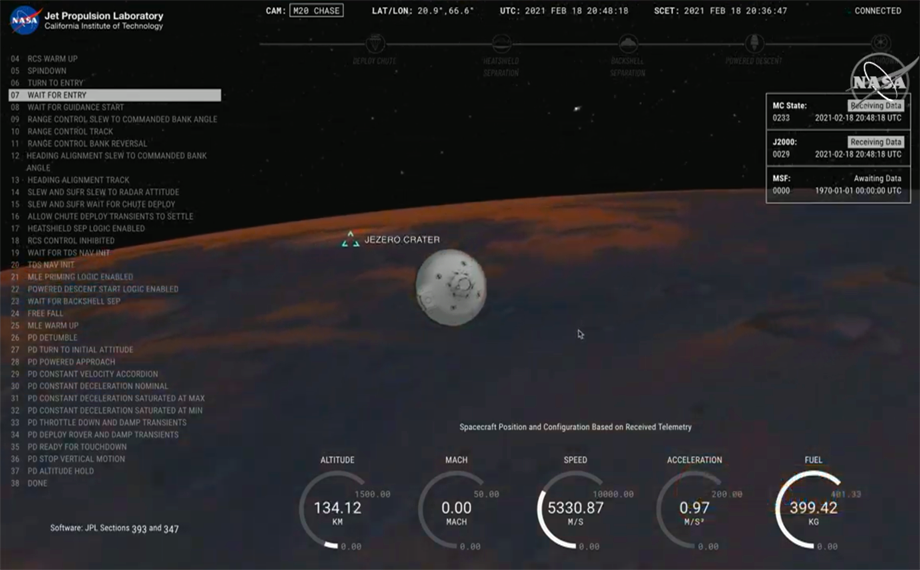 Perseverance spacecraft prepares to enter the Martian atmosphere. NASA/JPL, 2021.
 Perseverance spacecraft deploys its supersonic parachute. NASA/JPL, 2021.
 Perseverance on a parachute approaching Jezero crater. Picture from the Mars Recognisance Orbiter, NASA/JPL, 2021.
 Supersonic parachute slowing down the fall of Perseverance. Picture taken by the up-looking Parachute Cam on top of the Back Shell. NASA/JPL, 2021.


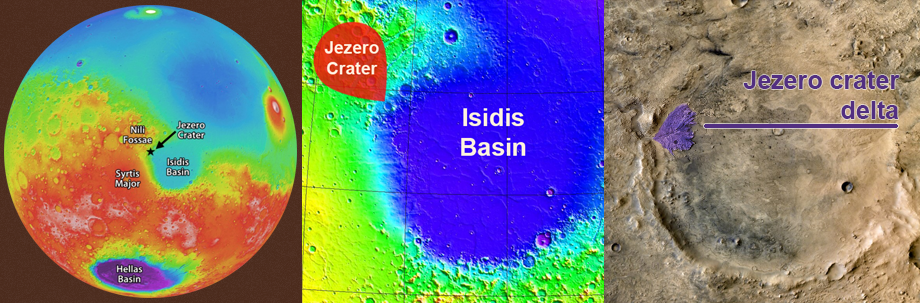 Mars and the location of the Isidis Basin, the Jezero crater and its delta. NASA/JPL, 2020.
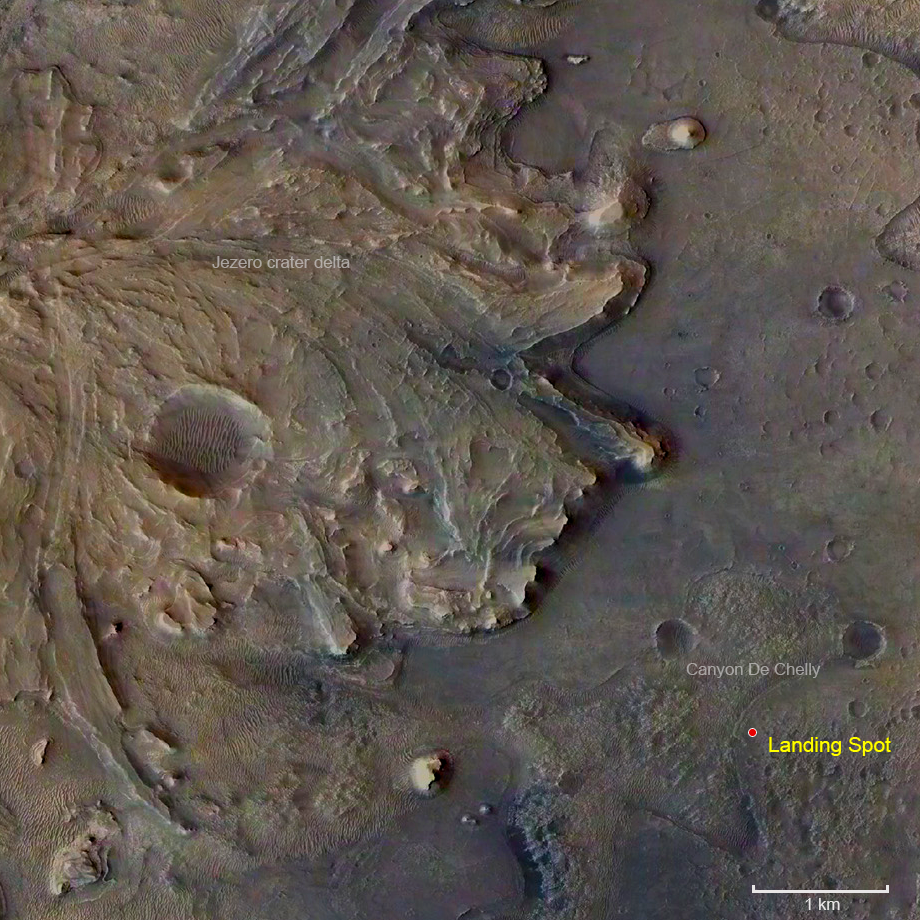 Perseverance’s landing spot inside the Jezero crater, southeast of the delta. Mars Reconnaissance Orbiter. NASA/JPL, 2021.
 Jezero crater’s geologic units showing the landing spot in a smooth unit, NASA/JPL, 2021.
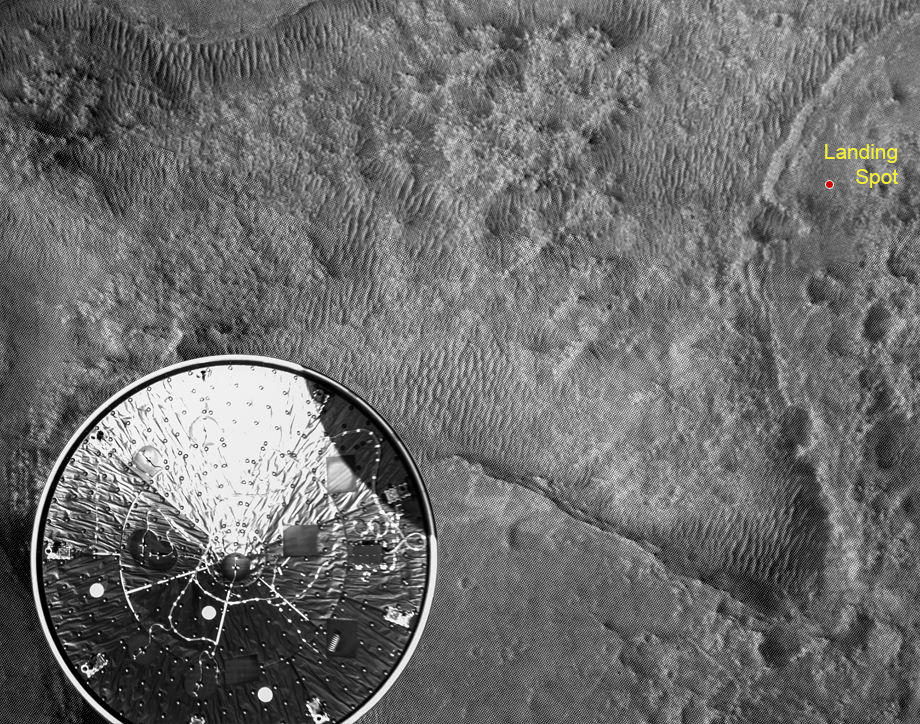 Heat Shield separation and Jezero crater with the targeted landing spot. Perseverance rover, NASA/JPL, 18 Feb 2021.
 Jezero crater, closer view and spotted landing site. Perseverance rover, NASA/JPL, 18 Feb 2021.
 Heat Shield in free-fall over Jezero crater, Mars. NASA/JPL, 18 Feb 2021.
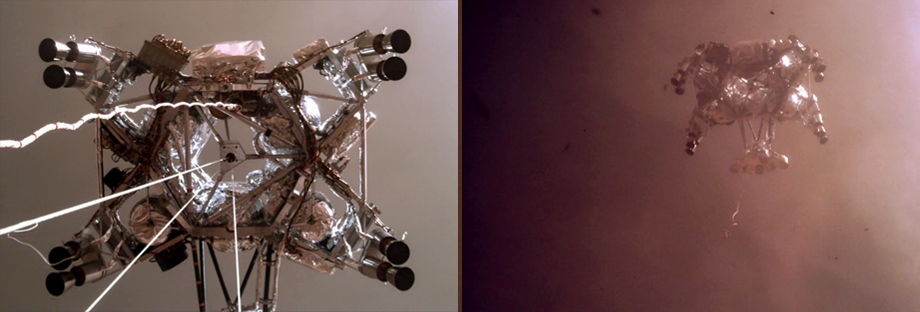 Descent Stage. Photograph taken by the Rover’s up-looking camera as it was being craned down and as it flew away. NASA/JPL, 18 Feb 2021.
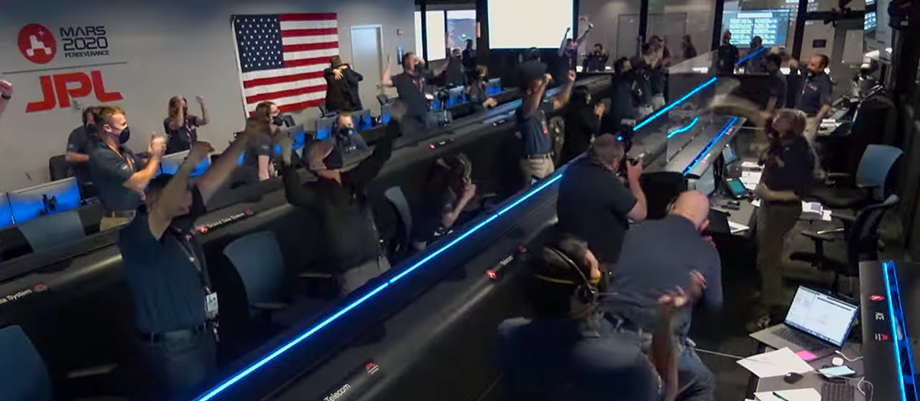 Celebrations at the NASA/JPL control room after the announcement of touchdown. NASA/JPL, 18 Feb 2021.
 Sample of participants in the live broadcast of Perseverance landing via YouTube on 18 February 2021.NASA, YouTube, 18 Feb 2021.
 First pictures sent by Perseverance from Mars arrived on 18 February 2021. NASA/JPL, 18 Feb 2021.
 Cleaner pictures of the landing zone on Mars, taken by the right and left Navcams on board the rover. NASA/JPL, 18 Feb 2021.
 A rock sample brought from our Moon in 1960s shows a surface similar to those seen on Mars. NASA/JPL, 18 Feb 2021.
 A closer look at surface rocks on Mars next to the rover’s wheel. Picture by SuperCam, NASA/JPL, 22 Feb 2021.
 Details of the surface of the rover taken by SuperCam. NASA/JPL, 22 Feb 2021.
 360-degree panorama of Jezero crater, taken by SuperCam. NASA/JPL, 25 Feb 2021.
 A section of the 360-degree panorama of Jezero crater showing the delta. Photo by SuperCam. NASA/JPL, 25 Feb 2021.
 Closeup of rock formation rising in front of the Jezero delta. Photo by SuperCam. NASA/JPL, 25 Feb 2021.
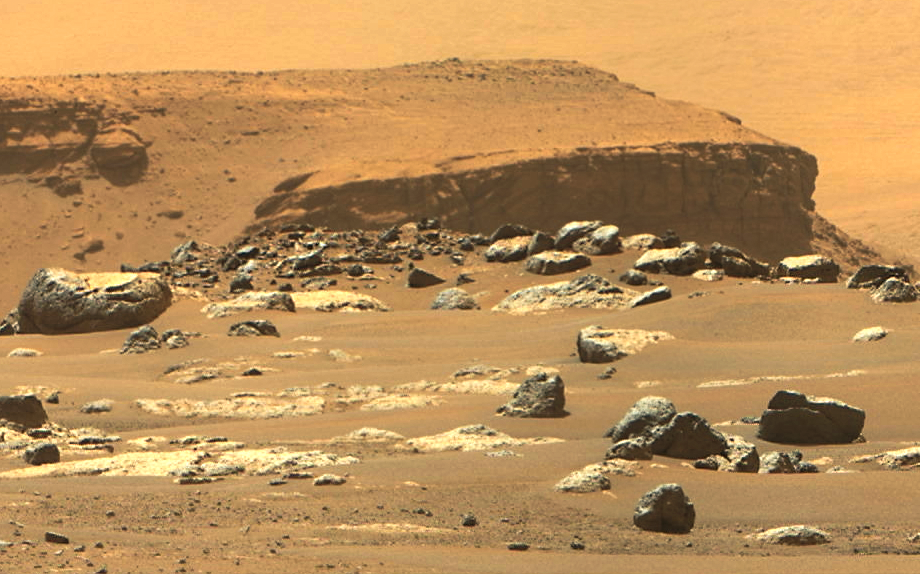 Full-resolution extreme-closeup of boulders in front of the rock formation. Photo by SuperCam. NASA/JPL, 25 Feb 2021.
 Jezero crater’s delta and inlet valley. Approximate angles of coverage of the pictures above from Perseverance’s landing spot. Mars Reconnaissance Orbiter, NASA/JPL, 2020.
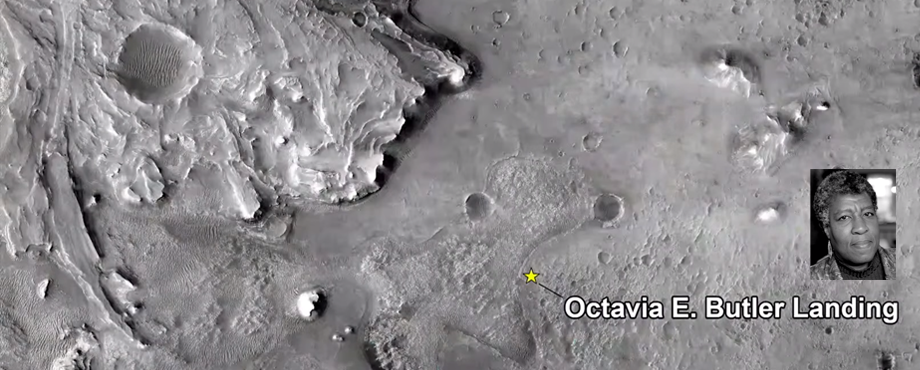 Perseverance landing site named after sci-fi writer Octavia E. Buttler. NASA/JPL, 05 Mar 2021.
 Top view of Perseverance rover, sol 13. Photo by SuperCam. NASA/JPL, 25 Feb 2021.
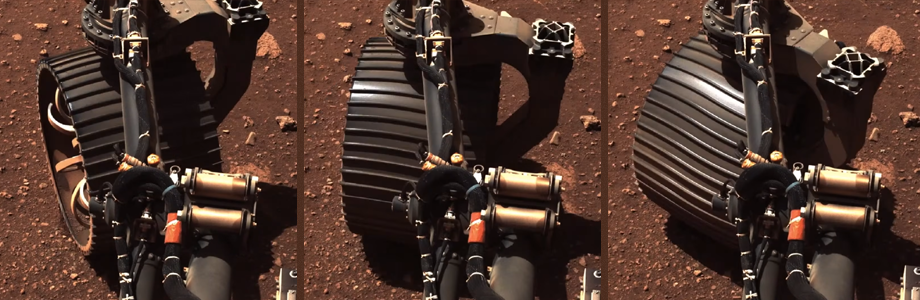 Tests of rotation of Perseverance’s front wheels. NASA/JPL, 04 Mar 2021.
 Wheel tracks showing the first run of Perseverance on Martian soil. NASA/JPL, 04 Mar 2021.


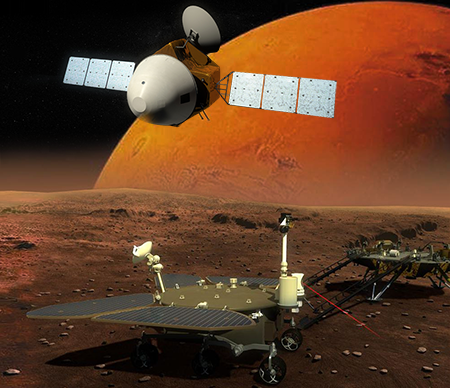


 Jezero Crater: Images from the High Resolution Stereo Camera aboard the European Space Agency (ESA) Mars Express orbiter, colourised through spectrometry to depict variations in soil composition. NASA/JPL, 2020.

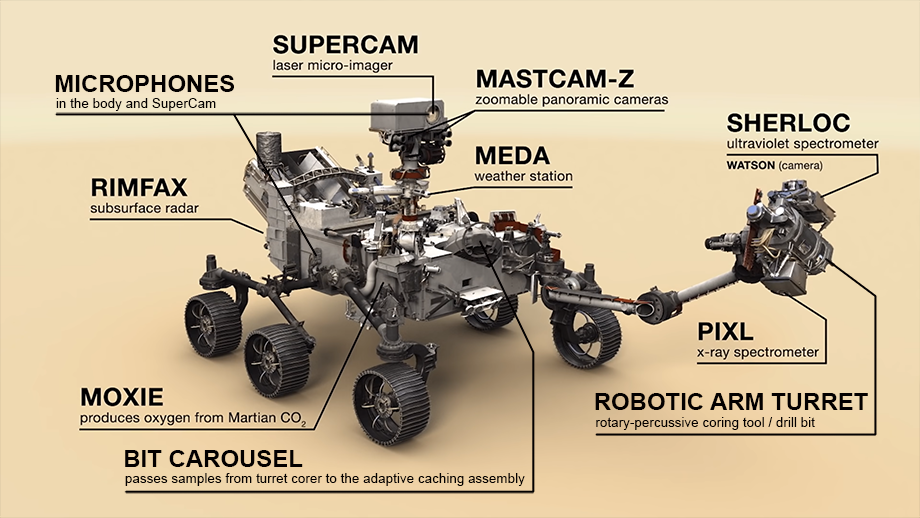 Instruments on the Perseverance Rover. NASA/JPL, 2020.
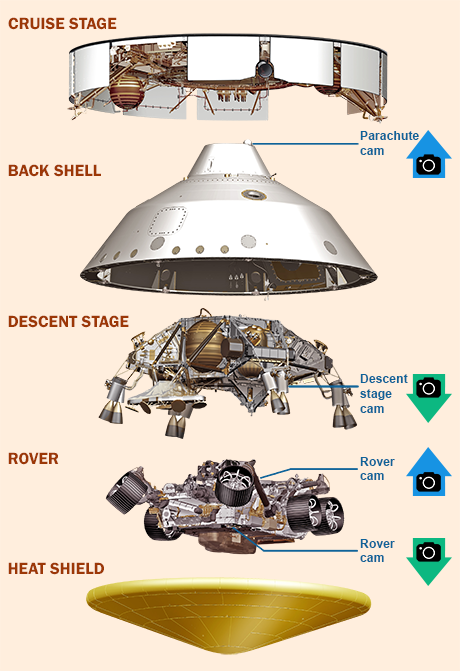
 Perseverance rover cameras. NASA/JPL, 2020.
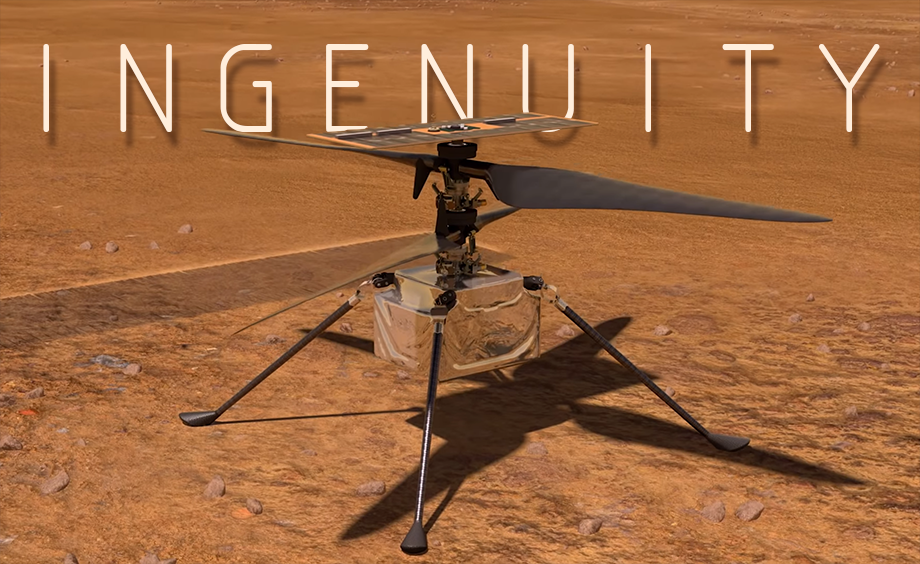 Ingenuity Mars Helicopter. NASA/JPL, 2020.